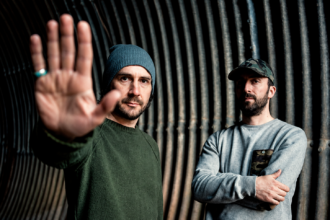
Kwes Darko, formerly Blue Daisy, returns with ‘God of the Youth,’ a five-track EP of blown-out bass and distorted drum machines on Black Acre
Kwesi Darko has spent the better part of a decade refusing to be what anyone wanted him to be, and “God of the Youth,” his debut EP under his own name, is the clearest argument yet that the instinct was correct. Out May 13 on Black Acre, the five-track release plants itself in a zone of blown-out bass, distorted drum machines, and industrial weight that has almost nothing in common with the warm Technicolor shimmer of his earlier work. It is deliberately difficult to hold, and that is precisely the point.
The backstory matters here. Around 2010, Kwesi Darko was operating as Blue Daisy and being positioned as the next Tricky, or the next Burial, or the next Flying Lotus, or the next Massive Attack, depending on which tastemaker was doing the talking. His debut album, “The Sunday Gift,” carried the playful energy of the experimental L.A. beat scene and rubbed it with a distinctly London grit, Technicolor synths strobing across dark corners. Mojo flagged him. Mary Anne Hobbs pushed him. He toured the world on the momentum. Then he stopped.
The Aliases and the Long Silence
The exit was not a clean one. Darko adopted a darker, rap-focused persona called Dahlia Black, stepped further away from the hype infrastructure that had built up around him, and spent the years since operating behind the scenes. His reputation as a producer remained intact; the solo releases did not come. “God of the Youth” breaks that silence and does so on terms that are entirely his own.
The lead single “Altitude“ sets the EP’s intentions in blunt, unignorable terms. Described by those closest to the project as concrete-heavy audio Brutalism, it flips between mutant grime and serrated digitalism, held together by bass weight that physically displaces the air in the room and synth noise calibrated to cause discomfort. There is nothing nostalgic about it. The Blue Daisy comparisons become immediately irrelevant on contact.
Across all five tracks, the EP pulls from grime’s bleary-eyed futurism, crystalline techno, and a strain of dub abstraction pushed to industrial extremes. The sudden stylistic shifts and juxtapositions are not accidents or indecision. They are the grammar of a producer who has spent fifteen years internalizing how sound behaves under pressure and is now releasing it all at once. Darko, on the record, has been direct about his intentions. “Listen, the anarchy is yours to interpret,” he said of the EP. “No explanation needed, it’s left to be interpreted however the listener decides. Once it’s in the world it doesn’t matter how or what I felt anymore. It’s about what they feel.”
What This Sounds Like in 2026
That statement would read as evasion from almost anyone else. From Darko, it reads as a production philosophy. “God of the Youth” does not offer the listener a handrail. It commits to a sound that is genuinely menacing, one that sits uncomfortably beside the current moment in UK electronic music, where polish and emotional accessibility have become increasingly dominant market values. Black Acre, long one of the country’s most forward-thinking independent imprints, provides exactly the right infrastructure for music that operates this far from the center.
What Darko has made here is not a comeback in any conventional sense. It is a reintroduction on terms so different from what came before that the lineage almost has to be taken on faith. But the weight and control on display across these five tracks belong to someone who has been building toward something specific for a long time. The anarchy, it turns out, is quite deliberate.
“God of the Youth” is out now on Black Acre.