




Nine Inch Nails and Boys Noize deliver a thrilling live-remix album that makes ‘Closer’ feel genuinely new. Pitchfork review
There is a version of “Closer“ that does not begin with its iconic kick-snare pattern. It opens, instead, on the 16th-note arpeggio that usually surfaces somewhere in the post-chorus, a mechanized, insectile phrase that most Nine Inch Nails fans have heard hundreds of times but never once as an establishing shot. It is a small, surgical intervention, and it makes the song feel genuinely dangerous again. That is Nine Inch Noize‘s signal achievement: it makes you forget, just long enough, that you knew what was coming.
Nine Inch Noize, released April 17 via Interscope/The Null Corporation, is the debut album from the collaborative project of the same name, comprising NIN mainstays Trent Reznor and Atticus Ross alongside German-Iraqi producer Alex Ridha, better known as Boys Noize, and Mariqueen Maandig, Reznor’s wife and How to Destroy Angels co-founder. The album arrived with the deliberate velocity of a Reznor production stunt: announced in plain text on desert billboards along the freeway to Indio, California, timed to Nine Inch Noize’s headlining appearance in Coachella’s Sahara Tent on April 11. It is designated Halo 38 in the NIN discography. The 12-track record, which mirrors the Coachella setlist almost directly, is a live-remix hybrid assembled, in Reznor’s own words, “all over the place,” parts captured live, parts laid down in hotels, studios, and planes. The crowd noise fades in and out at moments too precise to be accidental, and the whole thing sits closer to a studio document than a concert recording, despite what the applause might suggest.
How Boys Noize Rewired the NIN Catalog
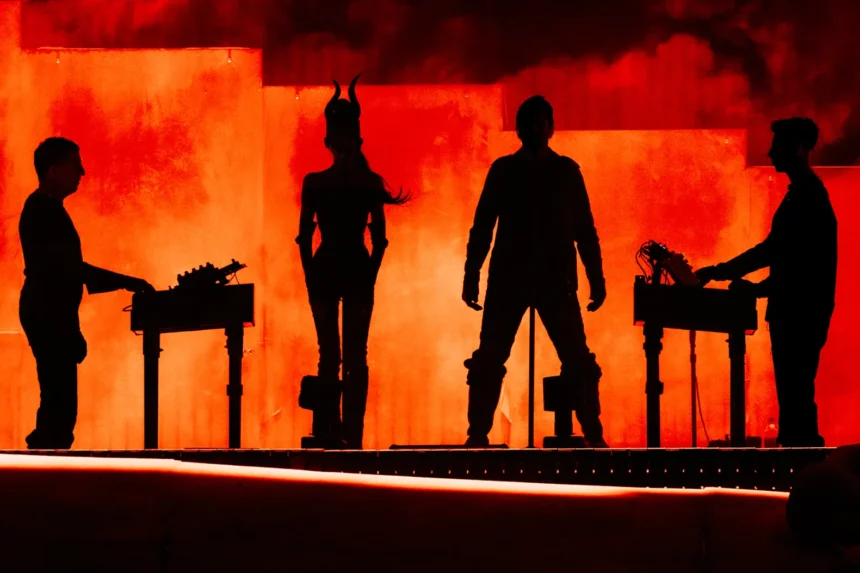
The project traces its roots to 2024, when Reznor and Ross commissioned Ridha to remix their Challengers score, a task Ridha completed, reportedly, without even watching the film. The resulting Challengers (Mixed) was a clearly superior listening object to the standard score release, and it made Ridha a rare new admit to the NIN inner circle. He subsequently received production credits on the Tron: Ares soundtrack and joined the Peel It Back tour as opening act, his set engineered to crescendo directly into a curtain drop revealing Reznor on a secondary stage buried in the crowd. By the time the Coachella set was designed, the unit had a choreographed troupe of dancers in gray bodysuits moving like a single organism across a foam-mountain stage, their formations periodically dissolving into pure chaos. It is, by most accounts, among the more visually arresting live productions Reznor has ever assembled, and that is a high bar to clear.
Stylistically, Ridha’s fingerprints are not difficult to trace. He brings the rave, which is a blunt way of saying he brings the thing that separates Boys Noize’s records from most electronic music adjacent to NIN: a clean, ultra-linear funk, thick smacking percussion, and a floor-consciousness that Reznor, historically, has mostly sublimated into something more introverted. The result is an album that functions differently than any Nine Inch Nails release in the band’s catalog. Where The Downward Spiral demands isolation, where The Fragile demands patience, Nine Inch Noize demands a room full of other people. That is not a criticism.
The Album’s Peaks and One Honest Caveat
“Heresy,” from The Downward Spiral, is the most transformed thing here. In its original form, it is a fascist march, menacing and blunt. Here, it opens on a brittle, eerie drum loop, with Maandig’s voice taking the first verse in a register that is genuinely unnerving before Reznor arrives for the chorus screaming “God is dead, and no one cares” over a single, fat synth tone. One review described it as landing somewhere between Purple Rain-era Prince and Godflesh, which is accurate enough to be alarming. The song, in this form, is materially better than the original. That is not a sentence that arrives easily. “Closer” has already been addressed, but it is worth noting that the crowd noise rising when that arpeggio registers, audible on the recording, is not a production trick. Those are real people realizing what they are hearing a half-second before they expected to hear it. The Soft Cell cover “Memorabilia,” previously a deep cut on the Closer to God single, throbs and squelches with a house-adjacent energy that feels exactly right in this context, and Reznor’s whispered delivery adds a layer of creepiness that the original, to its credit, did not need. “As Alive As You Need Me To Be,” the Tron: Ares single that arrived as NIN’s first new proper song in four years and felt underwritten in that context, closes the album with a cinematic energy it did not previously possess. The quasi-live format is mostly a strength. The crowd noise, however, is not. Faded in and out at curated moments rather than riding low throughout, it produces an effect uncomfortably close to a laugh track, a manufactured sense of communal experience that the music itself doesn’t need. Reznor acknowledged that the record might disappoint listeners hoping for the refined versions heard on the Peel It Back tour. He was right to flag it, though perhaps underselling how much the album delivers elsewhere.
What remains most interesting about Nine Inch Noize is what it says about the NIN project at this point in its life. Reznor built a band that was, for decades, architecturally a one-man operation, adding collaborators incrementally and carefully. Ross joined officially in 2016. Ridha arrived in 2024. The band, if we can call it that now, is expanding outward in ways that are audible. “Fun” was Reznor’s word for this album, offered with the particular self-awareness of a man who has spent thirty years asking audiences to have a bad time. Inside every joke, as he well knows, is a little truth.