




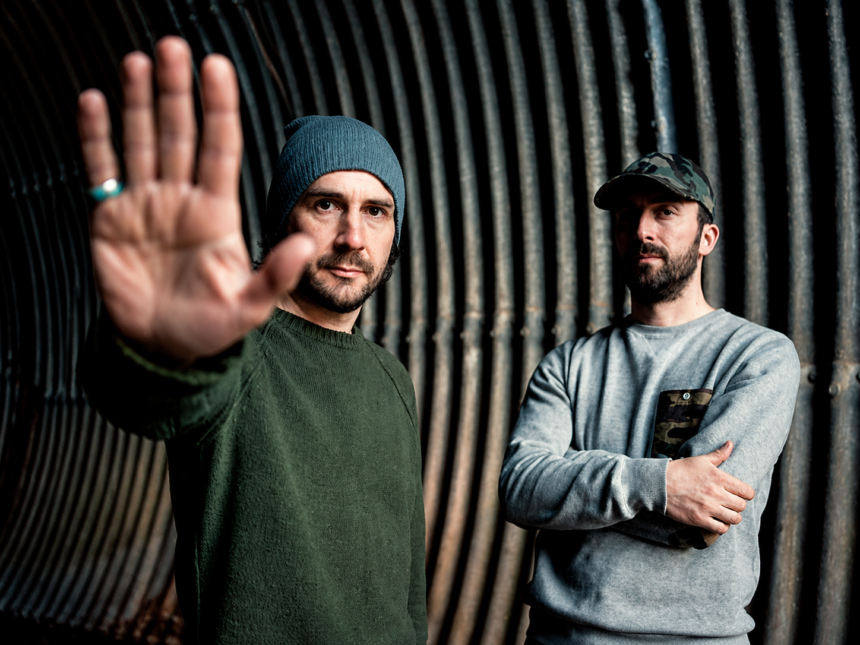
Boards of Canada release ‘Inferno,’ their first studio album in 13 years, via Warp Records. Stream the 18-track set now
Boards of Canada have ended their silence. Inferno, the Scottish duo’s fifth studio album and their first in thirteen years, arrived at midnight on May 29 via Warp Records. It is an 18-track, nearly 70-minute double album from brothers Mike Sandison and Marcus Eoin, and it is out right now.
The return has been building since at least May 2025, when fans discovered that a website used as part of the cryptic marketing campaign for 2013’s Tomorrow’s Harvest had quietly come back online, displaying the message “nobody home” in both English and Morse code. That signal grew louder in early April 2026, when unmarked VHS tapes began arriving in fans’ mailboxes, their return addresses traced back to Warp and the label’s digital storefront Bleep.
Posters bearing designs closely related to the duo’s classic 1998 debut Music Has the Right to Children surfaced in London, New York, Los Angeles, and Shibuya, Tokyo. On April 16, Boards of Canada released “Tape 05,” their first new piece of music in over a decade, a meditative track that does not appear anywhere on the final tracklist. The formal album announcement followed on April 22, accompanied by a 42-second trailer built around the duo’s recurring Hexagon Sun symbol pulsing through alternating colors.
The Signals Were Always There
The lead singles arrived May 7. “Introit” functions as a brief spectral overture, its retro-futurist synths scrambling against silence before ceding the floor to “Prophecy at 1420 MHz,” a slowly rotating, darkly hypnotic piece whose title references the hydrogen line frequency used in the search for extraterrestrial life and commonly associated with the unexplained 1977 Wow! signal.
The official music video for both tracks was directed by Robert Beatty, whose work with the band traces the Hexagon Sun’s signature iconography through a series of Chladni figure formations, the visual language matching the album’s occult-scientific tension. Critics immediately responded. NME praised the single’s “muffled, mutated” vocals and described “Prophecy at 1420 MHz” as a slow-building, ominous head-nodder unlike anything the duo had released since their early 2000s peak.
Inferno’s thematic architecture is dense even by Boards of Canada standards. Track titles including “Naraka,” “The Word Becomes Flesh,” “Blood in the Labyrinth,” and “The Process” position this as the most explicitly occult-leaning record since Geogaddi’s 2002 dark psychedelia. That comparison is not purely thematic.
Early full-album assessments from critics who attended the global listening sessions held simultaneously on May 22 in Tokyo, Berlin, Barcelona, London, Glasgow, New York, and Los Angeles have described Inferno as the duo’s most experimental work since Geogaddi, a record that sounds expansive and post-apocalyptic in equal measure, with increased live instrumentation woven through the duo’s signature analog texture.
18 Tracks, 70 Minutes, No Explanations
Writing and production is credited solely to Mike Sandison, with both members listed as instrumentalists and sound designers. The record is available in standard black 2LP vinyl, CD, digital formats, and a limited special edition red translucent 2LP pressing housed in a triple gatefold sleeve with a 16-page booklet. Certain deluxe copies include a hexagon-shaped 8″ flexi disc containing unreleased material.
Boards of Canada have never been a band that explains themselves, and Inferno offers no exception. The album title evokes Dante’s descent, but it arrives with no press release sermon and no public interview. What it does arrive with is 69 minutes and 51 seconds of music that, for those who have spent the better part of a decade waiting, sounds exactly like them, and somehow also like nothing they have done before. Stream Inferno below.