Jason Sudeikis revived Ted Lasso to send Justin Bieber onto the field for ‘Everything Hallelujah’ at the first World Cup final halftime show
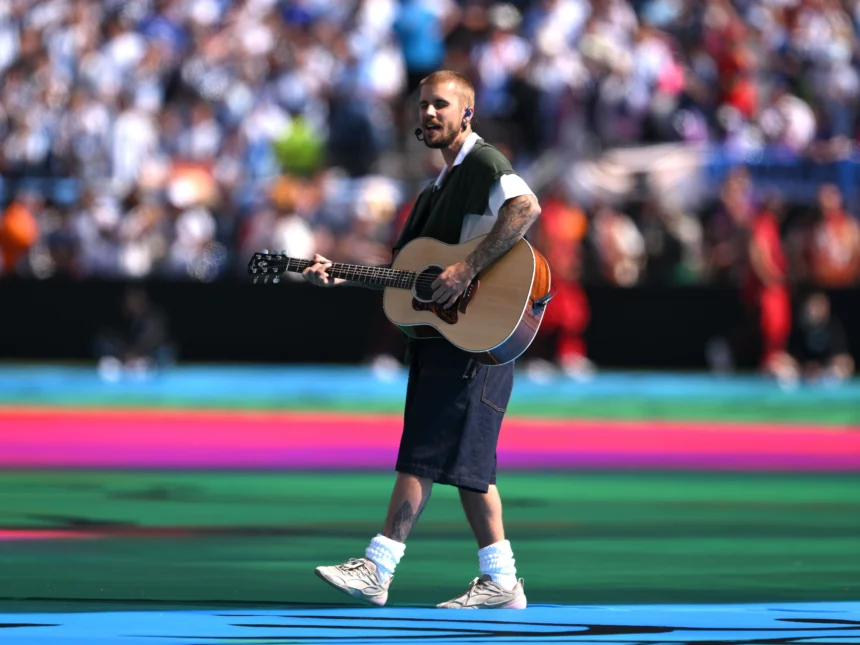
FIFA’s first-ever World Cup final halftime show needed a hinge between spectacle and sincerity, and it found one in a fictional football coach. Midway through the entertainment at Sunday’s (July 19) Spain vs. Argentina final at New York New Jersey Stadium in East Rutherford, N.J., Jason Sudeikis appeared in character as Ted Lasso, strolling the venue with Brendan Hunt’s Coach Beard and reviewing the show like a man watching training. His job in the segment was simple: substitute Justin Bieber onto the pitch to perform “Everything Hallelujah.”
Sudeikis played it exactly as the Apple TV+ faithful would want. “Coach, I gotta say, first half of halftime knocked my darn socks off,” he said. “How the heck is anyone gonna follow all that?” The answer arrived in classic Lasso logic: “You know what I think we need? We need some heart. You know, someone who has soul. Someone who can bring the love. Ooo. You thinking what I’m thinking?” Bieber then emerged with an acoustic guitar and his head down, absorbing a final pep talk. “All right, young man,” Lasso told him. “Let’s go! It’s your big shot. OK. Listen to me. Go out there. Don’t be nervous. Nobody’s watching. Make us proud.”
The Quietest Moment Won the Loudest Cheers
What followed was the emotional counterweight of the night. Bieber’s stripped performance of “Everything Hallelujah,” drawn from Swag II, landed as the earnest pause inside an 11-minute production stacked with Madonna, BTS, Shakira with Burna Boy, and a Coldplay-led finale. According to The Mirror, Bieber drew by far the loudest reaction of the entire show, with cheers rolling around the stadium the moment Lasso introduced him. FOX, broadcasting the tournament, pushed the clip out on social media almost immediately, where it became one of the night’s most shared moments.
The segment also carried a quiet strategic logic. The Lasso brand is the most beloved bridge between American audiences and soccer culture, and deploying Sudeikis at the exact moment FIFA imported a Super Bowl tradition onto its biggest stage was a wink at the entire experiment. The show, curated by Coldplay’s Chris Martin, leaned into that collision of worlds throughout, from the Muppets to conductor Gustavo Dudamel to a children’s choir closing with “We Dance.”
A Historic Break, and a Divisive One
Context made the halftime show a story in itself. This was the first final in World Cup history to feature one, capping the most attended edition of the tournament ever, with Argentina chasing the first successful title defense since Brazil in 1962 against a relentless Spain side that kept the match scoreless deep into the evening. Purists grumbled about the format: reporting from the stadium clocked the total break at more than 27 minutes, nearly double soccer’s traditional 15, and Spain manager Luis de la Fuente admitted before the match that his squad had planned for the extended interval as part of the tournament’s package of oddities.
For Bieber, the appearance extends a remarkably visible 2026 built on the momentum of his Swag era, and it positioned him as the tender center of a night otherwise engineered for maximum volume. For Sudeikis and Hunt, it was a reminder of how completely Ted Lasso has been absorbed into real soccer culture, five years after the character debuted as a fish out of water. A fictional coach telling a global pop star that “nobody’s watching” in front of one of the largest television audiences of the decade is the kind of joke that only works when everyone, in fact, is watching. On Sunday night, everyone was.