


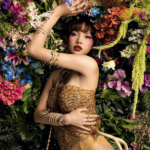


BombayMami and TroyBoi reunite on ‘Honey Liquor,’ a slow-burn trap and R&B groove. Hear the single and what it means for her debut album
Some collaborations announce themselves. This one just exhales. “Honey Liquor,” released Sept. 18, is the second meeting between BombayMami, the Indo-Swiss singer, and TroyBoi, the South London producer, and it moves with the ease of two artists who stopped auditioning for each other a while ago. Where their 2025 track “Beggin” ran on flute-lit drama, this one trades flash for pressure, a slow-burn trap and R&B groove that sits back and lets the bass breathe.
Two Worlds, One Groove
At around 110 BPM, “Honey Liquor” is cooler and more patient than its predecessor. That restraint is the point. BombayMami glides between R&B phrasing and South Asian ornament without flagging the switch, and the lyric sets temptation against discipline. “‘Honey Liquor’ is about keeping your eyes on the prize, even when temptation feels sweet and intoxicating,” she says. It is a quiet inversion of the usual club script. Most intoxication songs want you to dissolve. This one wants you to stay sharp.
The chemistry is not a marketing line. The two first linked on “Beggin,” TroyBoi’s wild card from his 2025 EP Rootz, where a relative newcomer held her own beside Punjabi heavyweights Jazzy B and Amrit Maan. BombayMami has called that first session two worlds meeting in rhythm, and she frames “Honey Liquor” as the deeper cut, her second song with an artist she calls her bro. The co-sign carries weight. TroyBoi’s remix of Billie Eilish’s “My Boy” is nearing 110 million Spotify streams, his sound scored Rihanna’s 2019 Savage x Fenty show, and “RedEye” with Justin Bieber has cleared 111 million. That he keeps returning to her table says plenty.
A Diaspora That Refuses to Pick a Side
TroyBoi has always built from texture, stitching trap and bass to rhythms pulled from a heritage that runs through India, China, Portugal and Nigeria. Lately he has been digging closer to the root, and Rootz leaned hard into the Bollywood his Anglo-Indian mother raised him on, including “Kabhi,” built around the voice of the late Lata Mangeshkar. “Honey Liquor” reads like the reward for that excavation, warmer and surer than the record that set it up.
BombayMami arrives from the other direction, and just as unbothered. Raised between India and Switzerland, she was Ta’Shan before she was BombayMami. Her birth name, Shanta, means peaceful, and her father used to tell her that a different attitude surfaced the moment she hit the stage, “a peaceful attitude,” he called it. That phrase became the title of her debut album, Peaceful Attitude, due in the new year, a record she promises will lace tabla, sitar and multilingual writing through modern production, and one she warns is less up-tempo than fans might expect.
She has spent two years making fusion feel like a premise rather than a party trick. “Fire in Delhi” and “Hot Boyz” folded Indian classical texture into R&B and pop. 2026 singles “Gulabi Mantra” and “Energy (Chak Dum Dum),” with Mannywellz, widened the frame. And then there is the image that turned her into a feed fixture: BombayMami carving down the Swiss Alps in a red lehenga, a clip past 7 million views across Instagram and TikTok. It is funny, gorgeous and quietly radical, which is a fair description of the music too.
The timing is not incidental. South Asian artists are sliding from the edges of festival bills toward the middle, and “Honey Liquor” makes its case without raising its voice. BombayMami has played BBC Radio 1’s Big Weekend, SXSW London and the Great Escape, and she sounds, on record and off, like someone who settled the question of where she belongs a long time ago. The diaspora, she keeps suggesting, does not have to choose. “Honey Liquor” is proof you can hold both, and make it sound this easy.