




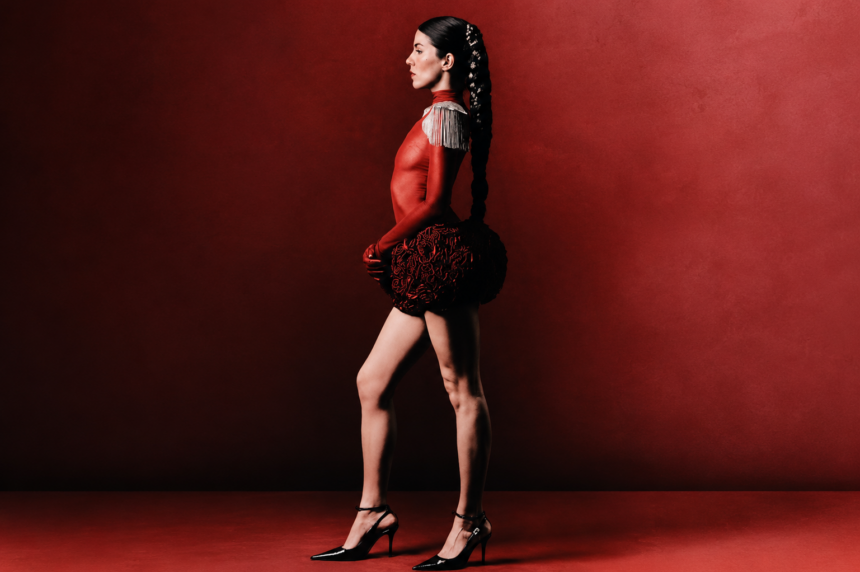
Marina Herlop’s self-released ‘Dja Dja’ pairs piano, flute and invented-language vocals into an immersive reworking of the Hero’s Journey
Marina Herlop has spent a decade proving she can build worlds out of almost nothing, a piano, a voice, a language she made up herself. On ‘Dja Dja‘, released Oct. 9, she builds one entirely on her own terms. The album is the Catalan composer’s fifth, and her first self-released record after a run on the influential experimental label PAN. Immersive and often deliberately confounding, it is both a return to the piano-led intimacy of her earliest work and a leap into something stranger and more cinematic.
The record arrives after the two albums that made her name. ‘Pripyat’ (2022) and ‘Nekkuja’ (2023), both on PAN, recast Herlop as an electronic visionary, layering polyrhythmic vocal experiments into music that felt beamed in from another dimension. Before those came ‘Nanook’ and ‘Babasha’, studies in piano minimalism. ‘Dja Dja’ folds both halves of her catalogue into one body, pairing the delicacy of the early records with the scale of the later ones.
A Hero’s Journey, Rewritten
What holds the album together is structure, even when the surface sounds like free play. Herlop conceived ‘Dja Dja’ as one continuous piece, each track keeping its own internal logic while contributing to the whole. Its foundation, she has said, is the archetypal Hero’s Journey, the mythic narrative shape that runs from Homer to Hollywood. Rather than retelling it literally, she reinterprets it so loosely that listeners are left to map their own meaning onto its arc. The result is music that feels both ancient and uncharted.
That duality is the album’s governing tension. ‘Dja Dja’ moves between fragile collages of piano and flute and vast, inter-dimensional compositions that swell into something close to the epic. Guiding all of it is Herlop’s voice, sibilant and harmonically dense, singing in the invented language that has become her signature, a private vocabulary assembled from fragments of real tongues and sounds of her own design. It is a language built for feeling rather than meaning, and here it carries the emotional weight the narrative withholds.
The Company She Keeps
It is tempting to reach for reference points, and ‘Dja Dja’ invites a few. There are shades of Björk‘s maximalist art-pop and Fever Ray‘s eerie theatricality in its vocal drama, and a trace of Diamanda Galás in its extremity. Structurally, the album owes something to minimalist composers like Steve Reich and Michael Nyman, whose patience and repetition echo through its longer passages. Yet Herlop never sounds like a student of any of them. Her Catalan roots surface in the music’s texture even as it conjures a fantastical space entirely her own.
The early singles mapped the territory. ‘Jaque’, which arrived in July, ‘Vas volant’ and ‘Bliss’ each revealed a different facet of the project, from hushed restraint to full orchestral ambition. Heard in sequence inside the album, they lose their edges and dissolve into the larger flow, which is clearly the point. ‘Dja Dja’ resists being broken into singles. It wants to be lived in from start to finish.
An Independent Leap
The decision to self-release carries its own weight. Leaving a tastemaker label like PAN to put out her most ambitious record alone is a statement of confidence, and ‘Dja Dja’ sounds like the work of an artist answering to no one. There is a freedom in its refusal to resolve, a willingness to stay difficult.
It will not be for everyone. The album asks for patience and rewards surrender rather than analysis. But for listeners willing to follow Herlop into her invented world, ‘Dja Dja’ offers something increasingly rare in experimental pop: a complete universe, strange and self-sufficient, with its own language, its own myth, and its own logic. A decade in, Marina Herlop has stopped borrowing other people’s maps. She is drawing her own.