


Yaeji returns with ‘ddr,’ a footwork-inspired club single and arcade-themed video on XL Recordings, reframing the dancefloor as healing
Yaeji has spent her career collapsing the distance between the arcade and the after-hours, and “ddr“, her euphoric new single, makes that merger literal. Released Monday (November 2) via XL Recordings, the track takes its name and its logic from Dance Dance Revolution, the cult arcade rhythm game, filtering the game’s frantic step-charts through the polyrhythmic machinery of Chicago footwork. It is her first single as lead artist since 2025, and it arrives with a clear thesis: the dancefloor is not an escape hatch but a site of repair.
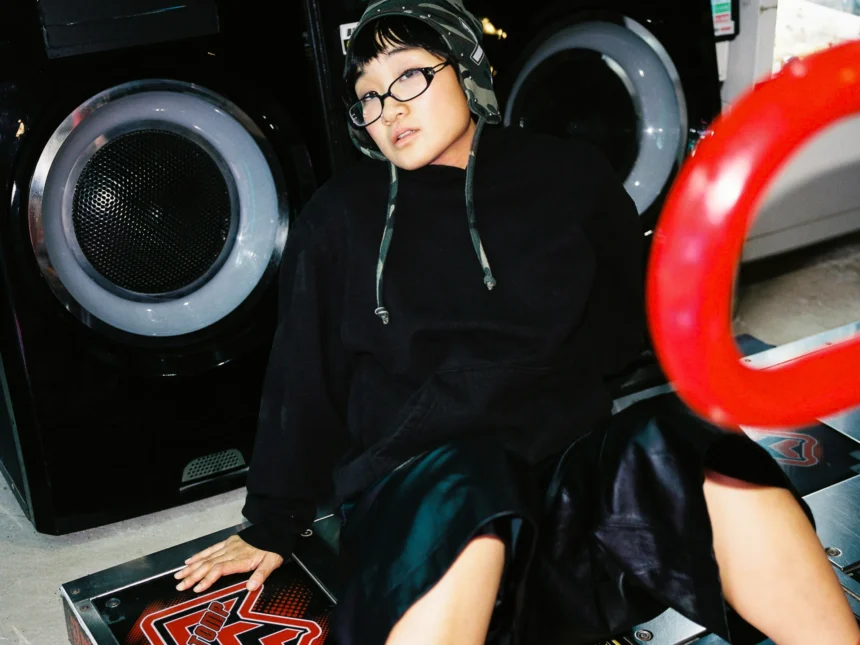
Sonically, “ddr” is among the busiest, most kinetic things Yaeji has made. Built with longtime collaborators Enayet and K Wata, two fixtures of New York City’s underground, the track trades her usual whispered intimacy for footwork’s stuttering 160-BPM urgency, all skittering triplets and bass that lunges in and out of the pocket. The accompanying video, directed by Giseong Jun, pushes the concept further, syncing those rhythms to the arrow-cued movement and neon visual language of the arcade cabinet itself.
Footwork as a Language of Care
What keeps “ddr” from reading as pure nostalgia bait is the way Yaeji rewires footwork’s competitive DNA. Born in Chicago’s battle circles, footwork is a music of one-upmanship, dancers facing off in tight rings. Yaeji flips that framework toward solidarity. The repeated invitation to “dance it all away,” she explains, is “not a call to escapism, but an affirmation of movement as healing,” a vision in which “the dancefloor offers a model for a more compassionate world, a space where people look after one another.”
That is not an abstract sentiment coming from her. Yaeji has consistently framed her club music as a product of the queer and immigrant communities of color that raised her as an artist, spaces where connection, not spectacle, is the point. On “ddr,” the arcade becomes a metaphor for exactly that: a game you technically play alone, reimagined as something you do together.
The Return of a Club Evangelist
“ddr” also marks a decisive return to the floor. Yaeji broke through in 2017 with “Raingurl,” then deliberately stepped back from the dance underground, detouring through the anime-styled 2020 mixtape What We Drew and the heavier, more introspective 2023 debut album With a Hammer. Her recent run, the self-liberating “booboo“ in 2024 and the silkworm-themed “Pondeggi” in 2025, signaled a gradual re-entry into club space, and “ddr” is the fullest commitment yet. After a quiet 2026, it reads as a statement of renewed purpose.
Crucially, she is not keeping the idea on wax. To mark the release, Yaeji has announced a club night this Wednesday at Paragon in Brooklyn, where fans can literally play Dance Dance Revolution before a night of DJ sets. It is a small, telling gesture that closes the loop between concept and practice, turning the song’s thesis about communal movement into an actual room full of people taking turns on a dance pad.
That instinct, to make the metaphor physical, has always separated Yaeji from the glut of producers mining Y2K kitsch for aesthetic shorthand. Plenty of artists have name-dropped arcade culture; few have used it to argue something. “ddr” treats a 25-year-old rhythm game not as a meme but as a design philosophy, a reminder that dancing in sync with strangers is its own quiet form of mutual aid.
The result is a track that works on two levels at once. On the surface, it is a propulsive, maximalist club cut engineered to detonate at peak hour. Underneath, it is a deceptively tender piece of writing about why people gather to move in the first place. For an artist who has always treated the dancefloor as sacred ground, “ddr” is both a homecoming and a manifesto, proof that Yaeji can still make catharsis feel like community.