
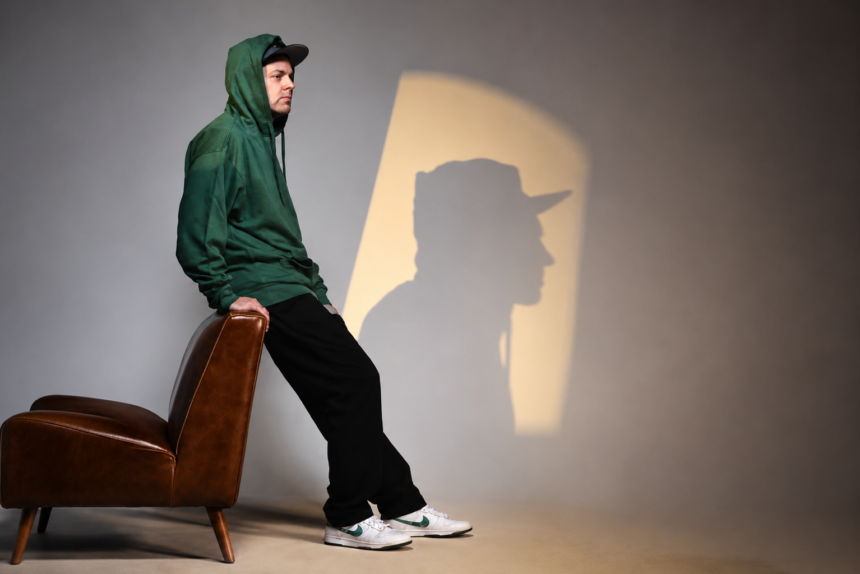
DJ Shadow on rebuilding ‘Endtroducing’ from his original MPC for its 30th anniversary tour and reissue campaign
Thirty years after it quietly rewired what a sampler could do, DJ Shadow’s Endtroducing is back in the room, and this time its maker had to rebuild it from the ground up to get it there. To mark the album’s 30th anniversary, the California producer born Josh Davis has launched a sprawling reissue campaign dubbed A Lifetime of Vinyl Culture, a US tour performing the record in full, and a December finale in London that pairs him with the BBC Symphony Orchestra. For a release that earned a Guinness World Record as the first commercially released album made entirely from samples, the retrospective is overdue, and Shadow knows it.
The mission behind the record was always bigger than the beats. “I intended to demonstrate to everybody, including non-hip hop people, that the sampler was a legitimate instrument,” Shadow tells Clash. “You can make songs that have emotion, even with it being instrumental.” That thesis, proven on an Akai MPC60 with a Technics turntable and little else, became the blueprint for instrumental hip-hop and a touchstone for everyone from Radiohead to the generation of producers still chasing his dusty, cinematic sound.
The Setup That Became a Legend
The now-mythologized minimalism of Endtroducing was never a creative statement. It was a limitation. “There was really no thought of using another instrument other than my MPC, simply because I didn’t have access to anything else,” Shadow explains. He chose the machine precisely because it was unproven territory. “I wanted to use something different because it was unproven and there was no chatter about it. Nobody had established themselves on that instrument within hip-hop yet.”
The samples came from obsessive crate-digging, much of it through the racks of Rare Records in Sacramento, the shop pictured on the album’s cover. What Shadow pulled from those bins he treated less like loops than like emotion, taking cues from the producers he revered. “When you listen to the A Tribe Called Quest stuff of the era, it’s so soulful, so deep and rich,” he says, citing Prince Paul and Public Enemy as artists who proved sampling could carry feeling, even rage. His own answer was quieter. Made largely on headphones, the record traded club impact for intimacy. “At no point was I thinking to myself, this beat has got to really hit hard so it sounds good in the club. It was just what sounds good in my head.”
Finding the Original MPC
The reason Shadow has never toured Endtroducing in full until now comes down to a technical ghost. The album was built without a true master tape, meaning no stems, no isolated drums or piano hits to rework on stage. Solving that required an archaeological dig into his own past. “I hadn’t seen my MPC, the original sampler that I used, in 20 years. It was just buried in storage,” he says. He eventually traced it to an Island Records exhibition in 2009, recovered it, had a friend refurbish the machine he assumed was broken, and then spent six months pulling the original samples off the unit one by one and rebuilding every song from scratch.
That painstaking restoration raised a question of ethics as much as engineering. Shadow was careful to clean up the recordings without rewriting them. “This isn’t about trying to rewrite the album,” he says. “I’m not adding superfluous scenes of Jabba the Hutt getting his tail stepped on.” The live show follows the album’s sequence, with Shadow searching for the line between honoring the original and finding fresh ways to engage with it.
The campaign is the first time Shadow, a famously forward-looking artist, has turned to face his own catalogue. Following his recent sequel to Nobody Speak, the reissue series continues with Preemptive Strike, a compilation of his Mo’ Wax singles. At 54, he frames the archival turn as a matter of timing. “I don’t want to wait until I’m 74. This is a good time to do all these things and tell all these stories.” The Endtroducing 30th anniversary edition is out now, with the Barbican show landing December 18.