
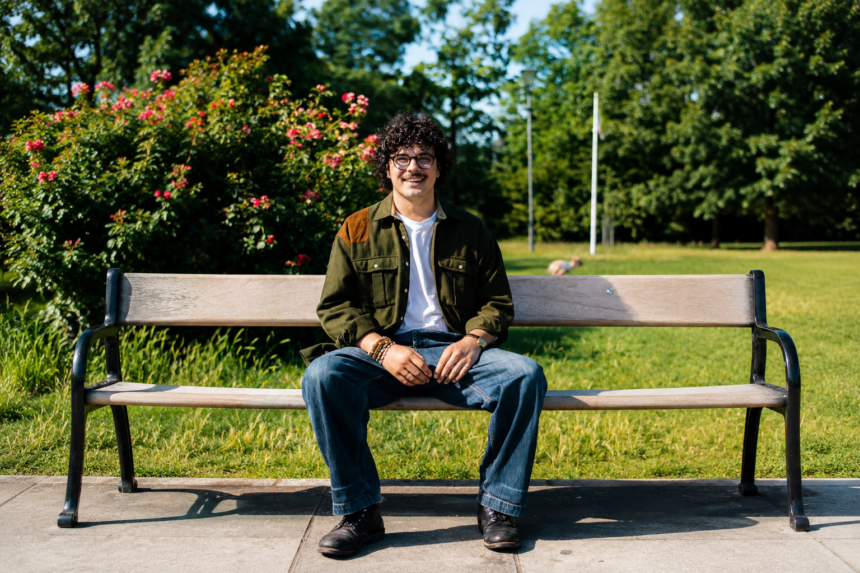
Indie-folk artist Luca Firth discusses community, room-as-instrument recording, and his visual second album ‘Big Eagle Hunting in the Wind’
Luca Firth watched an eagle drop a snake into an Italian field and knew he had his album title. The London-based indie-folk artist released Big Eagle Hunting in the Wind on July 1, his first record in five years, and it arrives sounding like a man who stopped waiting for the industry and built his own world instead. The image stuck with him for its sense of crossing between worlds. Ancient Central American civilizations, he points out, believed a city should be founded wherever an eagle caught a snake.
It fits. The record is a founding of sorts. Firth was 18 when he made his 2021 debut, A Year of Grace, alone in lockdown, all nautical imagery and heavy weather. He describes it as a breakup album. The new one, he says, is a falling-in-love album, and not only the romantic kind. Love of self. Love of place. Love of the people around you.
The Room Is an Instrument
Firth records the way he lives, close to home. The new album began in his family’s house in Italy, most of its core takes cut in a garage, built on the tactile percussion he has made a signature: cupboards, tables, the back of a guitar. What fascinates him is not the object but the echo. “The room is just as much of an instrument,” he says, and he keeps first takes wherever possible, convinced the humanity lives in the imperfections.
When the record felt 70 percent finished, he opened the door. He took it to Brooklyn to work with producer Oli Deakin, who records as Lowpines and had been working with CMAT just before her rise. Over one intense week they kept the garage takes at the record’s core and gave the songs new breath: more guitars, drums, piano, warm analog treatments. Friends play throughout, including his friend Gracie on violin, and on stage the songs shift again, because Firth refuses to hand out fixed parts. The band reads the song and answers it.
The years in between were not kind. Firth split with his label and manager after recording, watched the gigs dry up, and admits he felt lost at sea with a nearly finished album and no way to release it. On his Substack, where he shares recipes alongside music news, he has called the road to this release the uphill battle of his life so far.
An Ecosystem, Not a Rollout
What saved him, he says, was community. London’s singer-songwriter circuit can be isolating, no shortage of guys with acoustic guitars, but Firth found genuine friends in artists like May Payne, Sean Rogan, James Joseph and Edie Bens, the same crew who join him onstage at The George Tavern to sing together for the joy of it. That energy became the album’s whole architecture. Every one of its nine songs has a music video, threaded with connecting scenes into a feature-length visual album, made entirely independently with young filmmakers.
Two videos feature animation by Nastya, a Ukrainian animator who was around 18 when she made them, working around scheduled power cuts, and who understood the material with almost no direction. The film premiered free to the public at London’s legendary Olympic Studios on July 2, the day after release, with artwork by Mark Timmins tying the whole world together. Even the merch is communal: a fermented melon and habanero hot sauce made with his family’s food business.
Firth sees himself inside a bigger shift, pointing to acts like Geese and West Side Cowboy as proof that the young band, the real scene, is back. He picks three songs as his own compass points: “The Big Eagle” for the page turn, “Green Little Birds” for renewal, “Ice Cream” for the slow discovery that opening up to people was the point all along. In a cynical moment, he is betting on romanticism. On the evidence here, the bet is paying off.