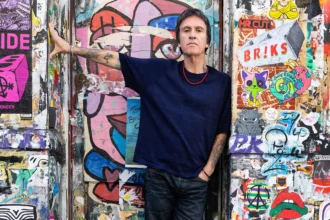





Japanese independent artist Cloud turns adolescent isolation into a slow-building wall of sound on ‘Nobody’s Dreaming’
Most songs are terrified of losing you. “Nobody’s Dreaming” is not. It sits quiet for the better part of thirty seconds, asking nothing, before the harmonics begin stacking and the room changes shape around you. By the time the synths thicken into something you can feel physically, you are already inside it. Cloud, the Japanese independent artist behind it, released the track in June.
That patience is a real risk in 2026, when skip rates govern how songs get built and most producers put the hook in the first eight seconds out of sheer fear. Cloud backloads everything. The payoff is that the song arrives as a discovery rather than an announcement.
A Song About Not Being in a Band
The restraint makes more sense once you know where the song came from. Cloud has said “Nobody’s Dreaming” grew out of repeated hardships during his adolescence. “I dreamed of achieving massive musical success like Nirvana or U2,” he told New In Music, but the reality was that he could not even form a band. He was isolated, and the ambition had nowhere to go.
That is the emotional engine, and it explains the shape of the thing. A song about enormous dreams held by somebody with nobody to share them with would sound false as a straightforward stadium anthem. Instead it is anthemic sideways. Big without announcing itself. Emotionally loaded without ever explaining what it is loaded with.
He talks about the two sides of his catalog in plain terms. “Overdrive,” his most-played song, is raw, hard-hitting rock, which he describes as “the crystallization of a cry from my soul.” “Nobody’s Dreaming” he calls a beautiful, classical-style piece. The through line is his own stated ambition: by transcending the boundaries of rock, he says, he can keep surprising people.
The American Audience He Didn’t Plan For
The numbers are the genuinely odd part of this story. Cloud has passed 160,000 Spotify plays, with roughly 80 percent of his listeners in the United States. “Overdrive” accounts for 120,000 of those on its own. Two of his songs have reached mainstream radio, and his name has turned up in more than 100 Western outlets.
None of that makes him a star, and the figures are modest by industry standards. What makes them interesting is the direction of travel. Most music moving between Japan and the US goes the other way, or arrives through anime placements and city-pop rediscovery on streaming platforms. An unsigned artist in Japan building an American rock audience from scratch, without a sync, is an unusual route.
Cloud has a theory about why it happened. American listeners, he says, are facing harder times than before, and “Overdrive” met them where they are, one person’s cry connecting with a lot of people under pressure. He also credits Global Sound Group, the London promotion company working his releases, which is a more candid answer about the machinery than most artists offer.
Whether or not the theory holds, the shape of the story is familiar enough to recognise. A teenager who could not get a band together spends years building a wall of sound by himself, and eventually hears it echoing back from six thousand miles away.
“Nobody’s Dreaming” takes half a minute to start. Then it does not let go.