



Actress returns to Ninja Tune with ‘Radical Frame,’ a high-fidelity reframing of the Black avant-garde featuring CASISDEAD and Rainy Miller
Darren J. Cunningham has spent close to two decades making electronic music that behaves like a half-remembered city at 4am, and on Radical Frame he finally turns the lights up. Released September 18 via Ninja Tune, the tenth solo studio album under his Actress alias is his first for the label since 2023’s LXXXVIII, and it trades much of the bit-crushed murk of earlier records for startling clarity. It is also his most explicit statement of intent. The album’s press notes frame it as an investigation of the Black avant-garde, pushing back against the assumption that experimental electronic music is a Euro-American inheritance.
That argument lands at the right moment. The lineage running from Detroit techno and Chicago house through to grime is still routinely flattened when the story of “experimental” electronics gets told, and Cunningham, a Wolverhampton native who launched his Werkdiscs club night and label in London in 2004 after injury ended his career as a West Bromwich Albion footballer, has always worked in the space between those worlds.
Clarity After the Haze
Anyone who has followed him since Hazyville (2008) and Splazsh (2010) knows the signatures: sketches that end before they start, piano motifs worn thin, kick drums sanded down to a rumour. Radical Frame keeps them but raises the fidelity. The opening pair, “The Experiment” and “Gimme Tha’ Fuckin’ Money Man,” are seconds-long bursts of muffled, chopped voices, deliberately illegible.
Then “Live By You” arrives. Grime MC CASISDEAD‘s verse starts bare over eerie synths before the track detonates into overdriven bass and scattered claps, his voice glitched until it stops registering as a voice at all. It is over in under two minutes, and it leaves a crater.
“Overchord” is the centrepiece and the album’s most generous moment. Ivor Novello-winning singer Naomi Kimpenu floats over mournful, spacious piano before a dusty break and a muted funk strum slide in underneath, and the whole thing settles into a patient, soulful midtempo house groove that owes more to basement parties than to any festival main stage.
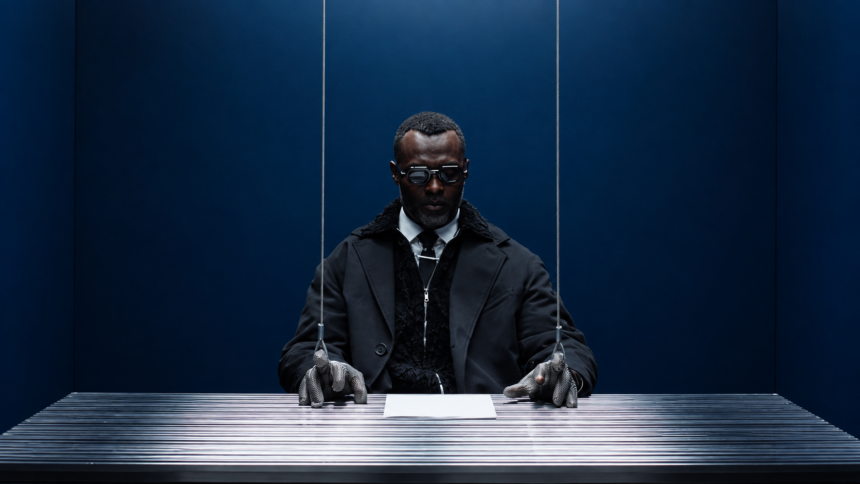
The accompanying film, directed by Anna van der Velde and commissioned by Ninja Tune, places Cunningham inside a self-built prison where he is both jailer and inmate. It is an apt image for an artist whose frame has always been of his own construction.
‘Sheets’ and the Question of Endings
The second half decompresses. “Cosmo” rides a bed of crackle into drifting ambience, “Withending” rolls keys and finger snaps before everything detunes, and “Paris” strips minimal techno down to sparse piano and filter sweeps until it quietly tightens into something you could drop at peak time.
Then comes “Sheets,” sixteen minutes long and the finest thing Cunningham has released in years. Preston artist Rainy Miller opens it questioning his own identity and confessing to overthinking, while rhythms shift between drum & bass tempos and rolling techno beneath treated vocals and ambient pads. Eventually the beats vanish into crashing waves, and the kick returns only as a faint, rapid heartbeat. It is devastating, and oddly hopeful.
The years between Ninja Tune releases were hardly quiet: 2024’s Statik, a second self-titled 2024 collage, the 2025 EPs Grey Interiors and Tranzkript 1, and Concrète Waves with modular synth pioneer Suzanne Ciani earlier this year via a reactivated Werkdiscs. Radical Frame distils all of it. The album’s own notes call the record an apotheosis and speak of handing the frame to the next artist in line, which has some critics wondering aloud whether this is a closing statement. Longtime listeners will remember similar speculation around 2014’s Ghettoville, before AZD arrived three years later.
For now, the album is heading to stages. Cunningham plays live sets at Unsound in Krakow on October 9, Robot Festival in Bologna the following night, Pitchfork Festival London on November 5, and Paris’s Gaîté Lyrique on December 12.
Whatever comes next, Radical Frame makes its case with precision. The haze has lifted, and the picture is sharper than ever.