



Tomorrowland Winter 2027 reveals its full lineup: Charlotte de Witte, Sara Landry, Afrojack and 150+ artists hit Alpe d’Huez, March 20 to 27
Tomorrowland Winter has revealed the first names for its 2027 edition, and the early bill signals a festival leaning harder into the underground than its big-room reputation might suggest. The alpine spin-off returns to Alpe d’Huez in the French Alps from March 20 to 27, 2027, running Saturday to Saturday in the ski-week format that has defined it since launch. This first wave is explicitly a teaser, with organizers calling it “an early announcement rather than the complete programme,” but it is enough to map where the festival’s head is at.
The headline names are familiar anchors. Belgian duo Dimitri Vegas & Like Mike, as close to Tomorrowland royalty as the brand has, sit at the top alongside Lost Frequencies, the melodic-house hitmaker whose crossover appeal makes him a natural fit for a crowd that spans tourists and devotees. Those two provide the mainstream gravity. What surrounds them is more interesting.
A Techno-Forward First Wave
The depth of this announcement tilts decisively toward techno and its harder, more club-serious strains. Nico Moreno, the French hard-techno figurehead whose sound has become one of the most divisive and magnetic in the scene, brings genuine weight to the bill, as does Space 92, a melodic and driving techno specialist. The inclusion of Hannah Laing, the Scottish DJ who has ridden the trance-techno revival to one of the fastest ascents in dance music, confirms the direction.
The booking of Korolova and Miss Monique, two of the most prominent women in melodic techno and progressive house, rounds out a selection that reads less like a tourist-friendly ski party and more like a curated statement about where European club culture is heading. Add rising names Novah and ELFIGO, and the pattern is clear. Tomorrowland Winter is using its first reveal to court the heads, not just the holidaymakers.
That matters because the winter edition has sometimes been dismissed as a novelty, a postcard version of the flagship Boom festival transplanted to the slopes. A first wave this committed to contemporary techno suggests the organizers understand the risk of coasting on spectacle alone, and are programming to keep the credibility intact.
Inside ‘The Great Library of Tomorrow’
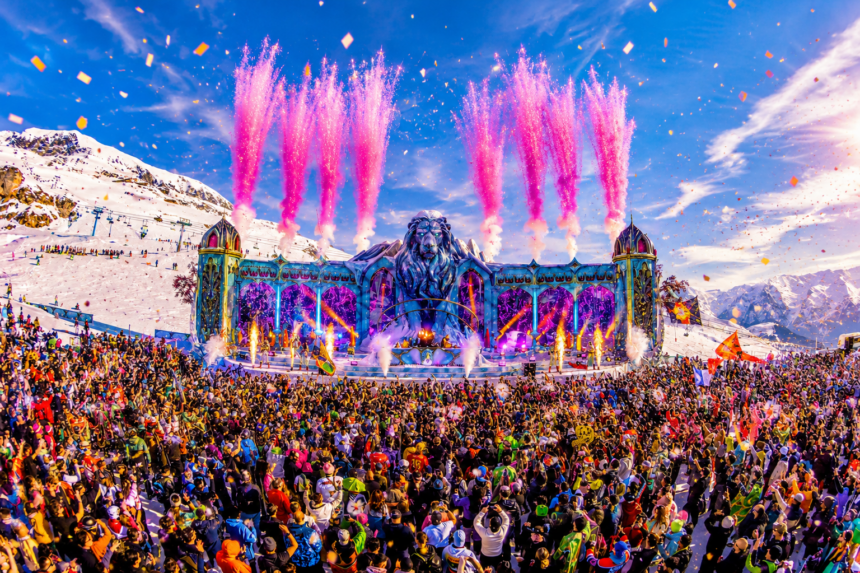
As ever with Tomorrowland, the production concept is doing as much work as the lineup. The 2027 edition carries the theme “The Great Library of Tomorrow,” described as a world inspired by an imagined library hidden inside the mountains. It is the kind of narrative framing the brand has built its global identity on, the sense that attendees are stepping into a story rather than simply a festival site.
That storytelling is not incidental. Tomorrowland’s stage design and world-building are arguably its biggest competitive advantage, the reason the brand has been able to franchise across continents and seasons without diluting its mystique. A library buried in the Alps gives the design team a rich visual language to work with, and it fits the intimate, enclosed feel of a mountain event where the stages are scattered across resort and peak rather than spread over an open field.
The practical details follow the established template. The festival again splits its programming between mountain and resort stages, with detailed stage schedules and the remaining names due in the coming weeks and months. For a brand whose on-sales routinely move with startling speed, the early reveal functions as much as a demand signal as an artistic one.
What the first announcement makes plain is that Tomorrowland Winter intends to be taken seriously as a dance event, not just a scenic getaway. With Dimitri Vegas & Like Mike and Lost Frequencies supplying the wattage and a techno-heavy supporting cast supplying the credibility, the 2027 edition is positioning itself as one of the more compelling stops on the spring festival calendar. The full picture is still coming into focus, but the outline already looks sharp.