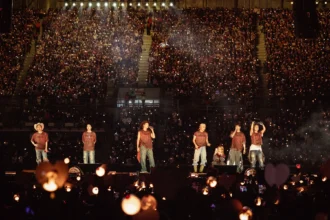





Miss Monique played Tomorrowland’s Mainstage for a third straight year, days after premiering her Biorhythm audiovisual show on the Freedom Stage
Olesia Arkusha has spent the past three summers turning up on progressively larger stages, and this weekend she reached the largest one in electronic music for the third year running. The Ukrainian DJ and producer, who performs as Miss Monique, played Tomorrowland’s Mainstage in Boom, Belgium, capping a festival run that also included the world premiere of Biorhythm, her first audiovisual production. She is the only Ukrainian artist on the 2026 Mainstage lineup, and given what the past four years have looked like for musicians from her country, that fact carries weight beyond the booking.
The Biorhythm premiere came first, on July 17, on the Freedom Stage, Tomorrowland’s second-largest arena. It drew roughly 15,000 people for a 90-minute set that quickly registered as one of the standout moments of weekend one. The venue was chosen deliberately. Following a major reconstruction ahead of last year’s festival, the Freedom Stage now houses more than 200 video panels and over 300 square meters of LED screens as part of a kinetic “floating sky” roof and wall installation, which is exactly the canvas a concept show like this requires.
Machines Versus Nature, Onstage
The concept is the interesting part. “The show is based on the contrast between the modern industrial world and nature,” her team explained. “Humanity has surrounded itself with metal, concrete, screens and endless information noise, yet nature has not disappeared. It continues to live, change and reclaim its space.” Arkusha framed it as reconciliation rather than conflict. “Biorhythm shows that despite today’s industrial world of AI and technology, nature still finds its way through,” she said. “The show tries to show that these two extremes are not in conflict, but in the balance.”
Musically she stocked the premiere with unreleased material, much of it from Siona Records, the label she founded and has built into one of melodic house’s more watchable young imprints. The set opened on an alternative version of her own “Concorde” and worked through cuts from BAUS, Kevin de Vries, Paradoks, and her own collaborations, a reminder that the visual spectacle is anchored to actual A&R work rather than borrowed heat.
A Rapid Ascent, Measured in Rooms
The trajectory is worth spelling out. Arkusha was born in Kropyvnytskyi and raised in Kyiv, and went from her first DJ sets to the world’s biggest festivals in a handful of years. She has since played Coachella, Ultra, and EDC Las Vegas, recorded a Cercle set at Montreal’s Biosphère, and became the first Ukrainian artist to land a season-long Ibiza residency. She is now in her second consecutive year at Hï Ibiza, playing every Thursday for four months, plus five appearances at UNVRS Ibiza alongside David Guetta, Anyma, and Carl Cox.
The industry recognition has followed the bookings. She won Best Breakthrough DJ at the 2024 Ibiza DJ Awards, took Best Progressive/Melodic House DJ in 2025, and entered the DJ Mag Top 100 poll at number 75. Her summer also takes in Kappa FuturFestival, Ultra Europe, Awakenings, Brunch Electronik, and Outside Lands.
Not everyone is convinced by the format. Some critics have argued that the big-screen audiovisual show, pioneered by Anyma’s Genesys and replicated since by Artbat, Camelphat, and others, is a template arriving at its expiration date. That is a fair debate about the genre’s direction. It is also somewhat beside the point of what Arkusha specifically represents right now: a Ukrainian artist, in the fifth year of a war at home, holding the largest platform in dance music. Biorhythm continues at Mandarine Park in Buenos Aires on October 3, Pacha New York on November 13, and Phantom in Paris on November 27.