



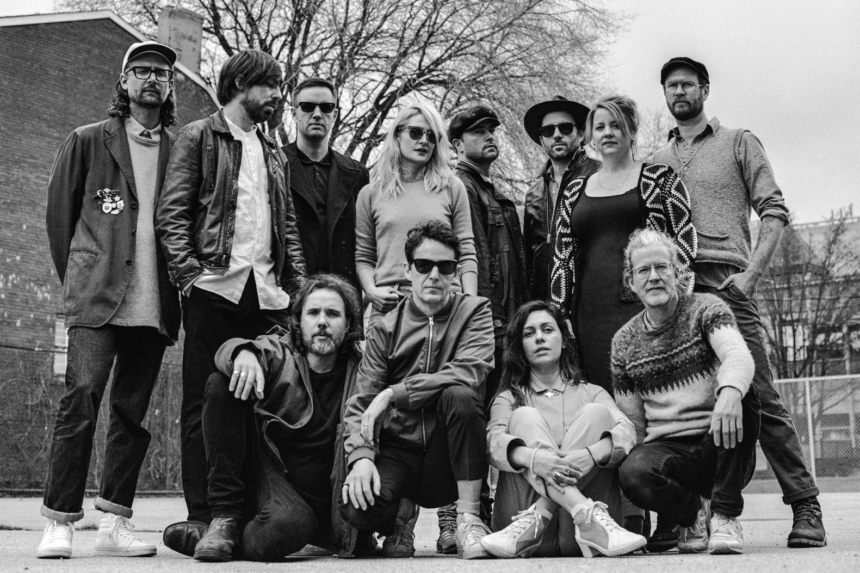
Broken Social Scene return after nine years with ‘Remember the Humans,’ a sprawling, communal indie rock record produced by Dave Newfeld
The question that haunts reunion-era rock is never stated but always present: is this band making new music because they have something to say, or because the nostalgia circuit has nowhere left to go? Broken Social Scene, the Toronto collective who spent the years after 2017’s “Hug of Thunder” celebrating the 20th anniversary of “You Forgot It in People“ with tours, reissues, covers, a graphic novel, a live album, a B-sides compilation, and a full documentary, have every reason to be suspected of the latter.
“Remember the Humans,” released May 8 via Arts and Crafts, answers that suspicion definitively. This is not a band coasting on legacy. It is a band that has arrived, nine years later, with something genuine to say. What makes that arrival convincing is the decision to reunite with producer Dave Newfeld, who shaped both “You Forgot It in People” and the 2005 self-titled album, the twin peaks against which every subsequent BSS record has been measured.
That pairing could have been a trap, an attempt to recapture a specific gravity. Instead, as Paste noted, “rarely have a producer and band been more suited for each other,” with Newfeld’s instinct for microscopic sonic drama amplifying the wide-eyed, open-armed wonder that has always defined the collective at its best. “Remember the Humans” is not trying to be “You Forgot It in People.” It is trying to be what Broken Social Scene sounds like now, at this stage of their lives, and it earns that attempt.
Extended Jams, Earned Stillness, and the Return of Feist
The 12-track, 49-minute record is built on patience. Extended jams stretch and breathe where tighter arrangements might have clipped them. Stretches of stillness hold their ground. The result is a record that rewards the kind of late-night headphone listening that Paste described as “perfectly suited” to this music. Opener “Not Around Anymore” arrives on gently strummed Stratocaster and easing horns before the rhythm section locks in, understated and unhurried. It sets a tone the album sustains throughout: communal rather than competitive, expansive rather than efficient.
Standouts include “Hey Amanda,” a blithe choral canter that New York Magazine called one of the album’s most hook-driven moments alongside “Relief,” and the closing “Parking Lot Dreams,” where a high-octave bass threads through strummed acoustic guitars and atmospheric strings as Kevin Drew delivers what feels like the record’s emotional center. The Wall Street Journal described the album’s thematic core as the band considering “the big changes its members have experienced as they matured both as individuals and as artists,” and that framing tracks. Charles Spearin has said directly: “We’ve had success, we’ve lost friends, we’ve lost parents, we’re at this ‘what happens next?’ stage in life.”
The guest returns carry that same emotional charge. Feist is back, as is Hannah Georgas, whose last contribution to the collective came more than fifteen years ago. Their presence is not decorative. On an album explicitly about remembering and reconnecting, these voices from the band’s own past arrive as the argument made sonic.
Why This Record Matters Right Now
Drew has spoken about the timing of this album with characteristic bluntness: “In 2026, you’re going to see a lot of resurgence of people going back to the roots of who they are, because things in their lifetime have gotten quite lost.
I think we’ve let each other down, and I think it’s art that always tries to prevail.” Treble noted that if “You Forgot It in People” was a document of revolutionary optimism in the wake of 9/11, “Remember the Humans” arrives under similarly destabilizing conditions, making a different but related argument: that communal music, music built on the fact of human presence and the value of connection, is not nostalgic. It is necessary.
The record is not flawless. Some of the hazier, more ruminative passages do not grip the way the band’s most direct moments do. But the overall impression is of a collective that has let go of the pressure to recapture its past and, in doing so, found something more valuable: the hunger that made the past worth revisiting in the first place.
“Remember the Humans” is out now via Arts and Crafts.