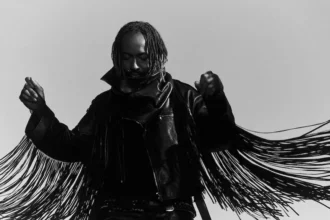


On the first night of Passover, in a 70,000-seat NFL palace in Inglewood, California, Ye stood on top of the world. Literally. Perched atop a massive orb-shaped stage structure while digital projections turned it into a slowly spinning Earth, the artist formerly known as Kanye West opened his first full U.S. concert in nearly five years with a visual declaration so on-the-nose it almost felt like a joke. It wasn’t. The crowd, packed wall-to-wall at SoFi Stadium for the first of two sold-out “Bully” era shows, roared from the moment he appeared.
The show arrived two months after Ye’s public apology for a years-long string of antisemitic statements, which he attributed to his bipolar disorder, first disclosed following a near-fatal 2002 car crash. It arrived one week after the release of “Bully,” his twelfth studio album and first solo LP since 2022’s “Donda 2,” which is tracking to debut at No. 2 on the Billboard 200 with approximately 117,000 first-week equivalent units, just behind BTS’s “ARIRANG.” According to distributor Gamma, the album pulled nearly 50 million Spotify streams in its first full day, making it the biggest hip-hop streaming debut of 2026 by their count. Ye, in other words, is not just attempting a comeback. He’s in the middle of one.
A Globe, A Grudge, and a Lighting Director’s Worst Night
He addressed none of it from the stage. No acknowledgment of the controversies. No statement, no gesture, no theater of reconciliation. What Ye offered instead were two hours of music, spectacle, and the particular brand of perfectionism-as-comedy that his most devoted fans have come to love and his critics have always found exhausting. He reprimanded his crew repeatedly throughout the night, halting “Good Life” three separate times because the lighting rig was displaying what he called “vibrating Vegas lights.” “Is this like an ‘SNL’ skit or something?” he said. “Stop doing the vibrating Vegas lights, bro. We went over this in rehearsal.” Later, as the globe’s animated spin felt too quick to his eye: “Make the earth move slower.” The crowd lost its mind both times.
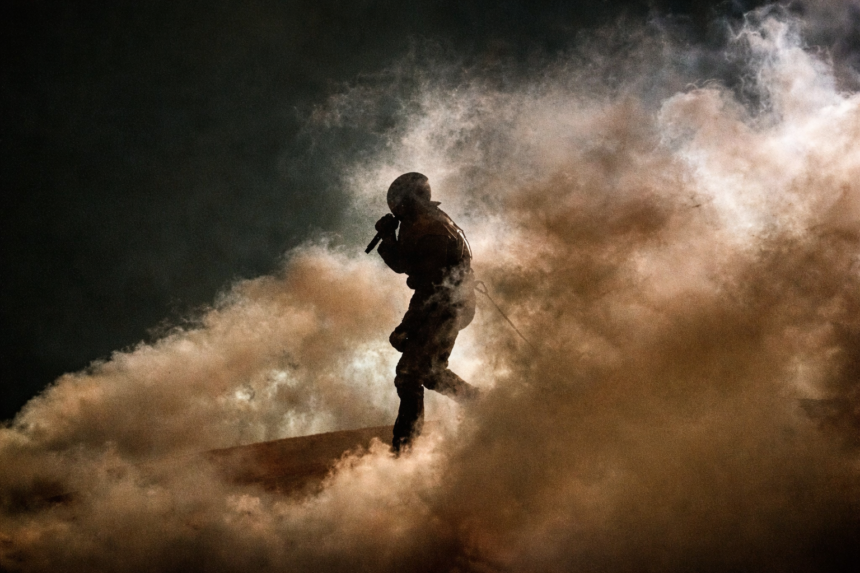
It was the most recognizable Ye moment of the evening, a reminder that even stripped of context, the man operates on a frequency most artists can’t locate. His control-freak perfectionism, maddening as it is, lands as art when it plays out in real time before 70,000 people. The production itself was genuinely impressive: fireworks, lasers, and a fog machine army that turned the stadium floor into a low-lying cloud. Ye, in a black mask, prowled the surface of his orb like a man who owns the planet he’s standing on.
The set opened with a clutch of songs from “Bully,” including “King,” “This a Must,” “Father” (featuring Travis Scott) and “All the Love,” all anchored by the album’s signature sonic register: soulful loops and polished production that nods toward his early catalog while reaching for something more interior. The album is a genuinely mixed bag. Its production, handled in part by James Blake and 88-Keys, has a warmth the last few Ye records lacked. But his vocal performance throughout “Bully” sits in a strange register, muted and emotionally underpowered in a way that invites the ongoing debate about how much, if any, AI was involved in the sessions before Gamma helped finalize the LP. Live, tracks like “Father” and “All the Love” carried more weight than they do on record, partly because the stadium’s scale amplified their atmosphere, and partly because the crowd was already primed.
The Old Catalog Still Wins Every Room
Then he went back. And when he did, the show transformed.
“Father, Stretch My Hands Pt. 1” hit like a starter pistol. “Can’t Tell Me Nothing” turned 70,000 people into a unified choir. “Black Skinhead” brought the aggression, “Heartless” brought the melancholy, and “Bound 2“ arrived like a relic from an era when Ye and his ego were generating more beauty than wreckage. He stood on the globe as Jay-Z’s verse on their classic 2011 collaboration echoed through the building, and for a moment the parallel was hard to ignore: both men, once inseparable, are now mounting comeback campaigns from very different starting points. Jay-Z on a victory lap. Ye trying to climb back from a crater he dug himself.
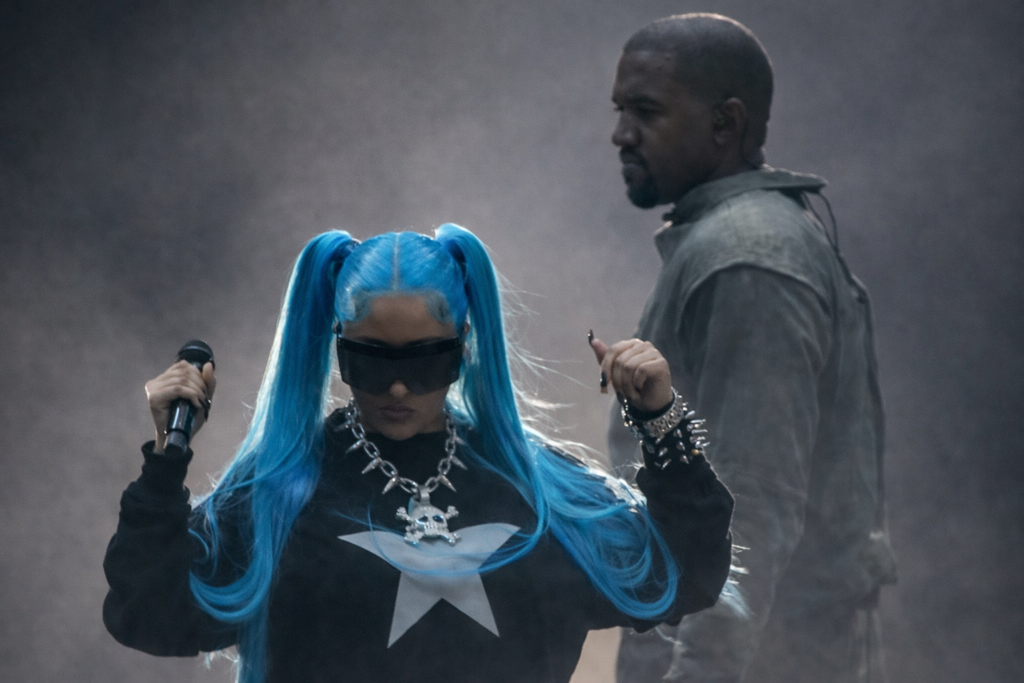
Don Toliver joined him for “Moon” and Toliver’s own “E85,” two of the cleaner transitions of the night. Then came the moment that stopped the room: North West, Ye’s 12-year-old daughter, walked out and performed “Talking” and “Piercing on My Hand” alongside her father. She carried herself with the kind of fearless ease that must mean growing up inside that particular orbit of celebrity is either deeply damaging or profoundly clarifying. The crowd responded with something approaching genuine warmth.
The closing run was where it all landed. “All Falls Down,” “Jesus Walks,” “Through the Wire,” “All of the Lights,” one after another, each one a reminder of what Ye built when his ambition and his humanity were in alignment. He closed on “Runaway,” his 2010 masterpiece of self-aware catastrophe, a song he’s always performed as both confession and warning. “Run away fast as you can,” he sang into the night. Nobody moved.
That’s the central tension of any Ye event in 2026: the music makes the argument he can’t make for himself. He didn’t need to address the antisemitism, the Hitler praise, the swastika merch, because the catalog did something crueler and more complicated. It reminded you of the full scope of what he built, and left you to sit with the math. The crowd at SoFi wasn’t there to forgive him. They were there because, on a purely musical level, the case for Ye’s greatness is still one of the strongest in American pop history. Wednesday night, that case got a full two-hour presentation. Night two followed on Good Friday. Europe comes this summer. The comeback, uncomfortable as it is, appears to be underway.