


Ye has reentered the room. On Saturday, March 28, the artist formerly known as Kanye West dropped his long-delayed 18-track album Bully on streaming platforms and accompanied it with a music video for “Father,” a Travis Scott-assisted cut that now stands as one of the project’s most talked-about moments. The timing is deliberate: two headlining shows at SoFi Stadium in Los Angeles are scheduled for April 1 and 3, giving Bully an immediate commercial stage to prove its footing.
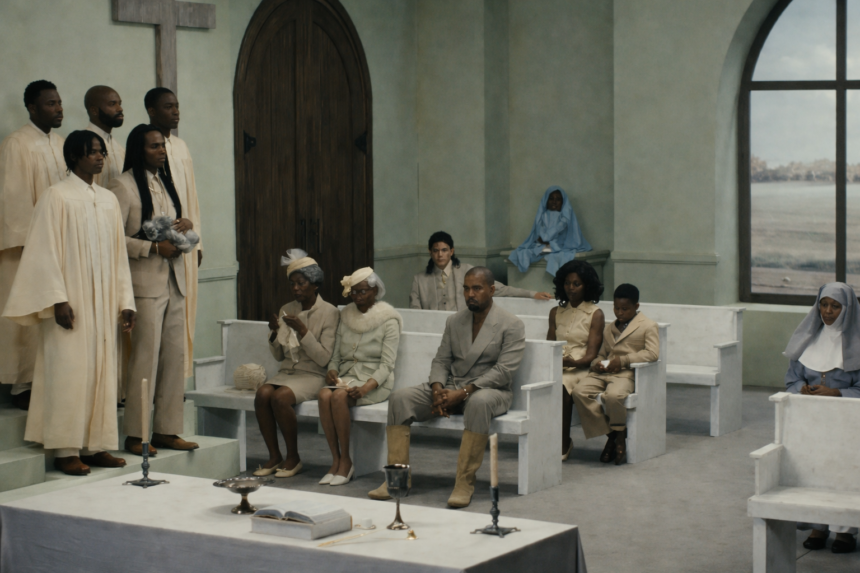
The “Father” video, directed by Bianca Censori in a single-camera setup, is set inside a minimalist church that fills slowly with chaos no one inside seems to notice. Card tricks that ignite into flames, a plate-armored knight leading a police squad to arrest a sleeping nun, a Michael Jackson lookalike seated quietly in the last row, and a UFO landing in the aisle: all of it registers as background noise to the congregation. Ye and Scott wear alien masks before pulling them down to reveal their faces, collapsing the distance between celebrity and extraterrestrial. It is surreal filmmaking that functions as social commentary, even if Ye has offered no statement about its intent.
A Comeback Built on Gospel Roots and Sample-Based Architecture
Bully arrives as Ye’s first solo album since Donda 2 in 2022 and the first release since the antisemitic remarks and erratic public behavior that dominated headlines across recent years. In January, Ye took out a full-page ad in The Wall Street Journal, writing in part: “I regret and am deeply mortified by my actions in that state, and am committed to accountability, treatment and meaningful change. It does not excuse what I did, though.” That public gesture preceded the album’s completion, according to sources cited by Rolling Stone, who confirmed recording had wrapped before the apology ran.
Sonically, critics who attended early listening events described Bully as a deliberate return to the sample-based production style that defined Ye’s most commercially dominant era. Gospel loops, soulful vocal samples, and heavy bass lines anchor the 42-minute, 18-track runtime. The approach draws comparisons to 808s and Heartbreak and My Beautiful Dark Twisted Fantasy, a pairing that positions the album as a correction toward his most critically celebrated period rather than a continuation of the experimental fragmentation that defined his output between 2020 and 2025.
The Collaborators and the Complications
The tracklist includes features from Don Toliver on “Circles,” Peso Pluma on “Last Breath,” CeeLo Green on the title track “Bully,” and Ye’s music director Andre Troutman on “All the Love” and “White Lines,” in addition to Scott’s appearance on “Father.” The chorus Ye delivers there says it plainly: “Bye-bye to my old self / Wake up to the new me / I used to be on Worldstar / Now I’m making Newsweek / I used to hang on the 9 / Now I bought two streets / Cottage Grove to King Drive / Yeah, this life is a movie.”
Fan reception, as tracked across social media since the album’s arrival, has been divided. Some listeners have praised the production’s restraint and atmospheric quality; others have found it too sparse. A separate subplot emerged when producer James Blake publicly requested his credit be removed from closing track “This One Here,” stating the officially released version bore little resemblance to what he had originally worked on with Ye. The album also continues to carry the weight of unresolved legal matters, including a March jury verdict that ordered Ye to pay $140,000 in a labor-related lawsuit involving a former contractor.
For now, Bully is on streaming platforms, the “Father” video is live, and the SoFi Stadium shows are weeks away. Whether the music earns its moment back is a question audiences will answer in real time.