



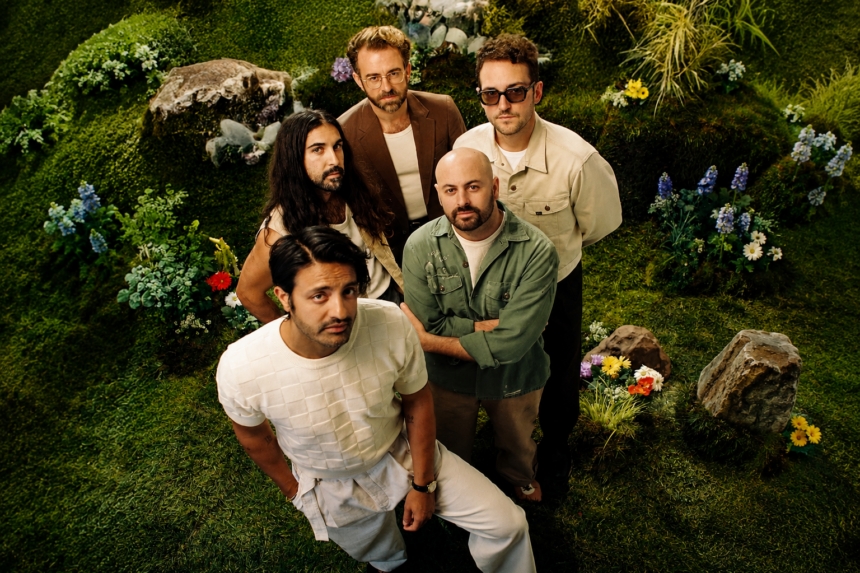
Young The Giant’s sixth album ‘Victory Garden’ is a focused, emotionally rich statement of radical empathy that distills 15 years of craft into something timely and timeless
Young The Giant released Victory Garden on May 1, 2026, and it is the most fully realized album the California five-piece have made. That is a substantial claim given the catalog it is measured against. Sameer Gadhia, Jacob Tilley, Payam Doostzadeh, Eric Cannata, and Francois Comtois have spent fifteen years building from the raw, electric immediacy of their self-titled debut through the arena ambition of Mind over Matter, the socially aware identity work of Home of the Strange, the atmospheric territory of Mirror Master, and the culturally rich immigrant narrative of American Bollywood. Victory Garden is where all of that arrives. Not at a destination, exactly, but at an understanding that the destination was never the point.
The album’s conceptual frame is community and radical empathy, and the record earns that frame rather than simply announcing it. Opener “Evergreen” establishes the stakes immediately: anthemic, guitar-forward, emotionally direct without being sentimental. The bridge cuts straight through: “Eye for an eye, is it karmic suicide? Though I try and I’ll try, but they’ll never take my life, I’ll survive, and I’ll be doing fine, but I’m afraid of the change and if I’ll still stay the same. And when I’m gone, hope the garden carries on.” That last line is the album’s thesis. What you tend, what you leave behind, what continues growing when you are no longer there.
Track by Track: What Victory Garden Actually Does
“Different Kind Of Love,” the album’s lead single, operates in the register of euphoric hope rooted in difficulty rather than denial. The production layers roiling bass and ethereal guitar around a lyric that refuses to let the listener stay comfortable in their despair: “Living in a house that’s not your home, living on a prayer you used to know. Give it to the wave but don’t let go.” That phrase, “give it to the wave but don’t let go,” contains an entire philosophy in ten syllables.
“Bitter Fruit“ brings the nostalgic uplift, a rock anthem that moves between dancing and ruminating without the transition ever feeling jarring. The unexpected chord progressions and melodic shifts mirror the lyrical content as it shifts throughout: wanting to feel alive again, wanting to laugh and cry like a child again. The acoustic guitar outro arrives as a gentle exhale after the song’s more energetic stretches, letting the message settle.
“This Too Shall Pass“ opens with a recording sample from NASA’s moon landing archives before building through accelerating drums, ambient chords, and Gadhia’s falsetto into something genuinely spacious. “Step off that ledge, my friend. You didn’t pay the branch. New leaves will grow instead.” That line, delivered over stripped-back vocal at the track’s close, is Victory Garden at its most direct and most affecting simultaneously.
“The Garden“ is the album’s emotional center: intricate acoustic riffs, echoing piano, and a lyrical argument about longing, growth, and hope that sustains itself for its entire runtime. “We live and die together, I’m not afraid because I’ll wait forever, love. I’ll meet you in the Garden, where it began.” The balance between powerful and gentle here is a production achievement as much as a songwriting one.
Why Victory Garden Is the Album That Matters
Victory Garden closes with “Life Is A Long Goodbye,” which strips everything away: just Gadhia’s vocal and piano, a bittersweet melody that functions as the album’s final word and its final breath. “What can you do when Father time is singing? And I’ve heard his melody floating soft in a dream. What does it mean? The end is just beginning.” It is a quiet, precise ending to a record that has earned its quiet.
Victory Garden is not the flashiest thing in Young The Giant’s catalog. It is the most grounded, the most coherent, and the most genuinely human. Fifteen years of craft arriving at something that feels like it always knew exactly what it needed to be.