



The Flaming Lips announce ‘The Teardrop Throbs,’ their first album in nearly seven years, out January 22
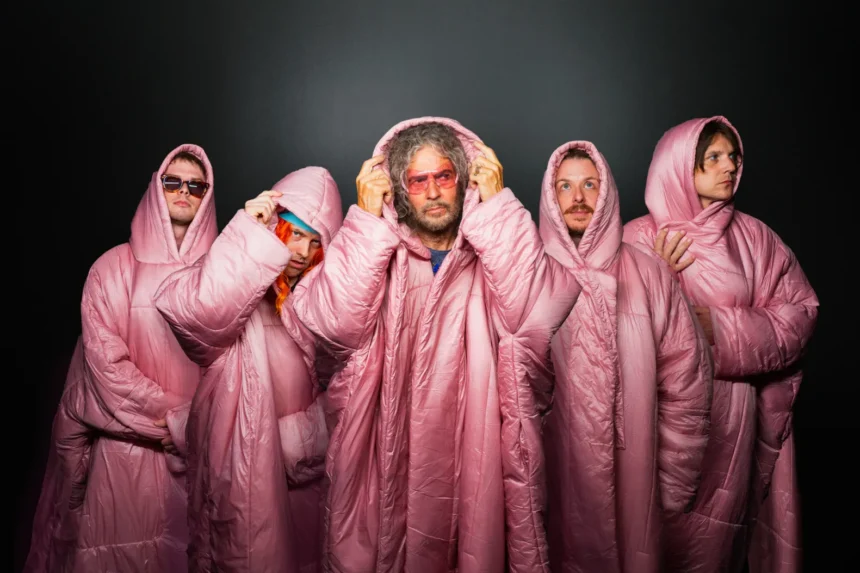
The Flaming Lips are back, and they are back changed. The Oklahoma psych-rock institution has announced The Teardrop Throbs, their 17th studio album and first in nearly seven years, arriving January 22 on Third Man Records. It is the band’s debut for Jack White‘s label, and the lead single, the typically titled “God Will Control the Werewolves,” is out now. For a group that has spent four decades treating weirdness as a first principle, this return carries real weight.
The gap since 2020’s American Head is the longest of the band’s career, and it has not been uneventful. The Teardrop Throbs is the first Flaming Lips album made without longtime members Michael Ivins and Steven Drozd, the latter a central creative architect of the band’s defining run. Whatever this record is, it is the sound of the Lips reconstituting themselves, and that context hangs over every track.
A Familiar Strangeness, Reassembled
The early signs suggest continuity more than rupture. “God Will Control the Werewolves” opens with an atmospheric, piano-led crawl before blooming into a lush groove, then cuts off abruptly with no outro, a structural tell that the album may flow track to track rather than stopping between songs. It is a small detail, but a telling one for a band that has always thought in terms of whole worlds rather than singles.
The production team reinforces the sense of homecoming. Wayne Coyne and company share the boards with Dave Fridmann, the longtime collaborator whose maximalist, bass-heavy fingerprints are all over the band’s best work, alongside Taylor Johnson and Scott Booker. The tracklist, meanwhile, is pure Flaming Lips absurdism, running from “You’ve Got Brain Damage” to the gloriously unwieldy “Instructions On How To Draw An Eyeball or How To Deal With A Loved One Who Is Addicted To Drugs.” They even revisit their own mythology, with “Ego Tripping at the Gates of Hell Part Two” picking up a thread from 2002’s Yoshimi Battles the Pink Robots.
Beneath the surrealism sits something tender. Coyne says the album draws on fatherhood, mortality, and the strange texture of everyday life, filtered through his love of classic cinema. “It occurred to me there will never be anything in my life as important as my two little boys,” he writes, a line that reframes the record’s cosmic whimsy as something grounded in the domestic. True to form, he resists pinning it down. “I don’t really believe any song has a fixed meaning.”
A Tour Built for Fans Who Pay Attention
The accompanying 2027 tour is designed as an event rather than a victory lap. The Flaming Lips will play two-night underplays in a handful of cities, deliberately small rooms for a band capable of filling much larger ones. Night one pairs a full performance of The Teardrop Throbs with a “Songs from the 20th Century” set spanning 1986 to 1999. Night two offers reimagined versions of the new album alongside a “Songs from the 21st Century” set covering 2002 to 2020. The band is promising deep cuts it has not played in decades, and some it has never performed at all.
The dates run from Nashville and New York in January through Los Angeles and Chicago in February, closing in London in April. It is a format that rewards obsessives, the kind of fans who have followed the Lips through gummy skulls, parking-lot experiments, and 24-hour songs, and it signals a band more interested in meaning than scale right now.
That feels like the point. The Teardrop Throbs arrives as a reintroduction, a long-tenured band testing whether its particular magic survives a lineup overhaul and a new label home. On the evidence of “God Will Control the Werewolves,” the strangeness is intact. The album is out January 22 via Third Man Records.