



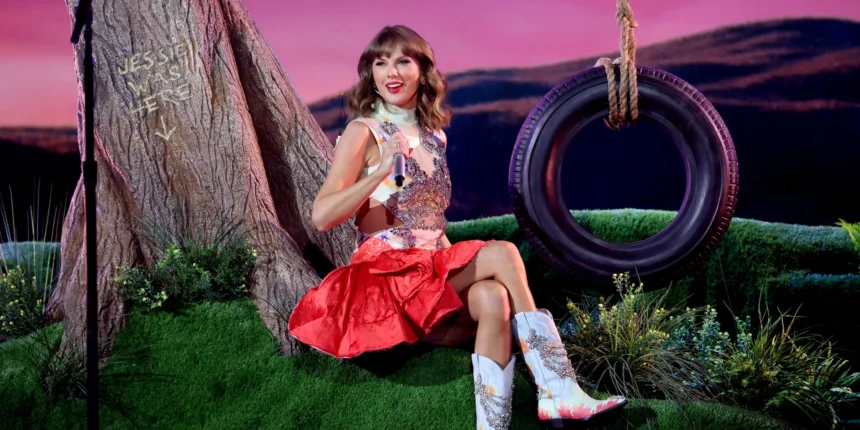
Taylor Swift returned to the CMA Awards after 13 years, mashing up ‘I Knew It, I Knew You’ with ‘Our Song’ alongside Keith Urban. Watch the performance
Taylor Swift went home to country music on Wednesday night, and she made an event of it. Performing at the 60th annual CMA Awards in Nashville on November 18, the global superstar returned to the ceremony’s stage for the first time in 13 years, mashing up her new ‘Toy Story 5’ anthem ‘I Knew It, I Knew You’ with ‘Our Song,’ the title track from her 2006 self-titled debut. It was a homecoming staged with full awareness of the symbolism, a pop titan circling back to the genre that built her.
The performance doubled as a reminder of how far back her roots run. Swift last played the CMAs in 2013, when she sang ‘Red’ with Vince Gill and Alison Krauss and accepted the Pinnacle Award. Her history with the show stretches further still, to her first attendance in 2006, the Horizon Award in 2007, and her 2009 Entertainer of the Year win, which made her the youngest artist ever to claim the honor. Returning in 2026, with her 26th career nomination in hand, she closed a loop more than a decade in the making.
A Star-Studded Walk to the Stage
Swift framed the number as a journey, literally. The medley opened backstage, with the singer walking the venue’s corridors past a parade of country royalty. Brad Paisley polished a CMA trophy as she passed. Little Big Town posed for a photo. Sugarland’s Jennifer Nettles and Kristian Bush fell into step beside her. At Brooks & Dunn’s card game she tried on a cowboy hat before passing it to host Lainey Wilson, then slipped on sunglasses for an encounter with Eric Church. Finally, the legendary Bill Anderson handed her an acoustic guitar, and she stepped into the light.
Onstage, she was not alone. Keith Urban joined her, playing banjo while Swift strummed a sparkling blue acoustic, and the two leaned into the country textures that ‘Our Song’ wore from the start. Halfway through, Swift pivoted from the new single into the old favorite, rocking out to the track that first introduced her to the format nearly two decades ago. For a crowd packed with artists who watched her rise, the throwback landed as both nostalgia and tribute.
Why the Moment Mattered
The timing is not accidental. ‘I Knew It, I Knew You,’ Swift’s contribution to the ‘Toy Story 5’ soundtrack, was produced with her frequent collaborator Jack Antonoff and arrived nominated for Single of the Year, a nod that pulled her back into the country-awards conversation she largely left behind as her pop career exploded. She first debuted the song at the film’s Los Angeles premiere in June, and the CMA performance gave it its biggest stage yet.
The award itself went elsewhere. Ella Langley’s ‘Choosin’ Texas’ took Single of the Year, part of a night that also opened with a Dolly Parton tribute led by Gill and Wilson, who hosted for the third straight year. Swift did not leave empty-handed in stage time, though. She presented Brooks & Dunn with the CMA Willie Nelson Lifetime Achievement Award, praising the duo’s catalog as “eternal bangers,” a characteristically Swiftian endorsement that doubled as a nod to the community welcoming her back.
For the industry, the performance read as more than a nostalgia play. Swift’s return to the CMA stage signals a renewed, if selective, engagement with country music at a moment when the genre is enjoying a commercial surge and crossover stars are moving fluidly between formats. Whether ‘I Knew It, I Knew You’ marks a one-off or the start of a deeper reconnection, Wednesday’s performance made the case that Swift can still command the room that first made her a star. Thirteen years away did nothing to loosen her grip on it.