



Elvis Costello’s ‘My Aim Is True’ box set spans 104 tracks, 52 unreleased, tracing how Declan MacManus became Elvis. Our review
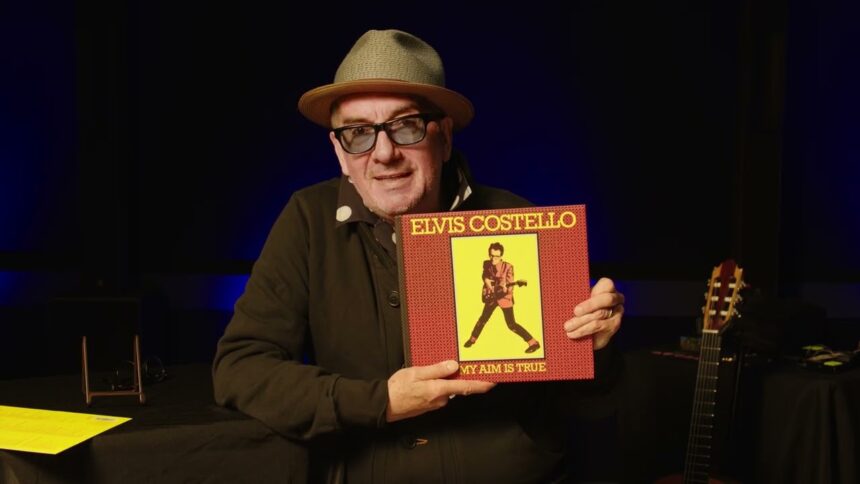
Anniversary box sets usually arrive as monuments. Elvis Costello wanted something closer to a crime scene. ‘My Aim Is True (49th Anniversary Edition)’, released Oct. 2 via UMe, expands his 1977 debut into five CDs and 104 tracks, 52 of them previously unreleased, in order to answer a question bigger than the album itself: how did Declan MacManus become Elvis Costello? The answer is messy, funny and occasionally thrilling, and it makes the case that the debut was not a finished statement but a snapshot of someone still deciding who to be.
Costello was not an easy sell on the idea. When a 50th anniversary celebration was first proposed, he found the concept preposterous. “It made my teeth itch,” he writes in the set’s opening pages, adding that he refused to see the record displayed like a precious relic. The slightly cheeky 49th-anniversary framing is the result, along with a 72-page essay, unseen photographs, handwritten lyrics from his notebooks and diary entries from 1976. Costello co-produced the collection with Steve Berkowitz.
Building the Blueprint
The five discs work as chapters. The first is a new remaster of the album, made from the original 1977 analog tapes. ‘The Blue Print’ gathers acoustic recordings and demos from before the sessions, ‘The Stranger In The House’ charts the transformation across 28 songs, ‘Becoming The Attractions’ follows his new band as it seized the material, and ‘Covered In Clover’ captures the only time Costello and Clover played the album live, in 2007.
The early material is where the box earns its weight. This is the sound of a young songwriter being rejected by every publisher and A&R man in London until Stiff Records finally heard something. Demos like ‘Jump Up’ find him trying on vaudeville whimsy, a hint of the all-round entertainer he would later become. The diary entries add bite: he waved off Bruce Springsteen as trite, even as songs like ‘Walk On’ and ‘Radio Soul’, the blueprint for ‘Radio Radio’, borrowed openly from him.
The Album at the Centre
At the centre is still the record itself. Produced by Nick Lowe with the Marin County band Clover backing him, ‘My Aim Is True’ was made on almost no budget, with little overdubbing and Costello singing live on nearly every track. Released on Stiff on July 22, 1977, it reached No. 14 in the UK. Its leanness remains its power, the songs arriving fully formed even when the arrangements feel like borrowed clothes.
That tension is the most revealing thread in the box. By the time the album came out, Clover’s relaxed swing had already given way to the Attractions, a seething garage band that understood both where Costello came from and where he needed to go. Hearing the same songs move from one band to the other is like watching a sketch become a weapon.
A Box That Refuses the Glass Case
None of this makes for casual listening. At 104 tracks, the set is built for the devoted, and a few finds, such as ‘Jump Up’, have appeared before in different versions on earlier expansions; the album was previously reissued in 1993, 2001 and 2007. Newcomers may be better served by the remaster on 180-gram vinyl, due Oct. 16.
But as a portrait of an artist in the act of becoming, it is hard to beat. Costello was not just making a debut album in 1977. He was laying foundations for the next five decades, absorbing punk’s energy without surrendering to its rules. ‘My Aim Is True (49th Anniversary Edition)‘ does exactly what its reluctant curator wanted: it keeps the story moving instead of sealing it behind glass.