


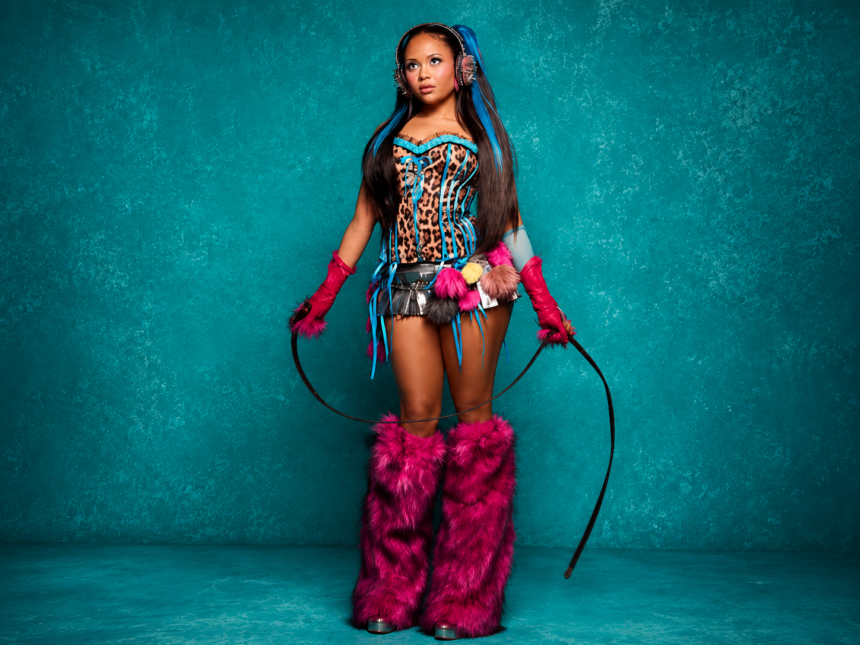
MOLIY’s ‘Baddies <3 MOLIY’ is a maximalist Afro-dancehall party record built on star features and cross-continental swagger
MOLIY built a global hit almost by accident, and “Baddies <3 MOLIY“ is her attempt to prove it was no fluke. The Ghanaian-American singer arrives at this 12-track mixtape, released July 31 via gamma, carrying the weight of “Shake It To The Max (FLY),” the Afro-dancehall smash whose remix with Silent Addy, Shenseea and Skillibeng climbed to No. 44 on the Billboard Hot 100 and went Gold on more than 500,000 units sold in the U.S. The question hanging over this project is whether MOLIY can convert one viral phenomenon into a sustainable artistic identity. Her answer is to go bigger, louder and more crowded, a maximalist bet that mostly pays off.
The record positions itself as a manifesto for confidence, a soundtrack for what its own press materials call global “baddie” culture. That framing could read as thin, but MOLIY grounds it in craft. The production, drawing from Afrobeats, Caribbean dancehall, alté and futuristic pop, rarely sits still, and her writing leans into a braggadocious, pleasure-seeking swagger that has become her stock-in-trade. On the Yinka Bernie-produced opener “TOMETO,” she is all self-assured strut, framing desire as a foregone conclusion rather than a plea.
A Record Built On Its Features
The most striking thing about “Baddies <3 MOLIY” is how deliberately communal it is. MOLIY seems to love making club records with artists she admires almost as much as she loves making them at all, and the guest list reads like a map of the current cross-continental pop underground. “BODY GO” pairs her with Grammy winner Tyla, a link-up that feels less like a marketing play than a natural meeting of aligned sensibilities. Dancehall royalty arrives via Shenseea and Skillibeng, while “ACCRA GIRLS” enlists Ghanaian rap icon Sarkodie for a hometown nod that grounds the record’s global ambitions in something specific.
The strongest sequencing move is “JETSKI (FRIKI),” where MOLIY places French-Congolese singer Theodora beside Dominican rapper Yailin la Más Viral, stitching Francophone African cool to Caribbean Spanish-language grit without a visible seam. Elsewhere, Nigerian star Mavo turns up on “PRETTY MAMI,” and her sister Mellissa appears alongside contributions from Br3nya and bees & honey. The breadth is the point. This is an artist arguing that her sound has no fixed borders.
When Maximalism Meets Diminishing Returns
The mixtape is not without its indulgences. It includes yet another remix of “Shake It To The Max,” a decision that is easy to understand and harder to defend. When a song is that catchy, additional versions almost justify themselves, but leaning on the hit that made her also underscores the project’s central tension. At 32 minutes across 12 tracks, “Baddies <3 MOLIY” moves fast, and its relentless party energy occasionally flattens the emotional range, with club-bangers climbing over one another in a way that can blur individual songs into a single euphoric rush.
Still, that rush is real, and it is the product of genuine curatorial instinct rather than algorithmic guesswork. MOLIY, who first broke through on Amaarae’s viral “Sad Girlz Luv Money” before “Shake It To The Max” made her a headline act, understands that her gift is connective. She is the fluent center of a conversation happening across Accra, Kingston, Lagos and beyond, and “Baddies <3 MOLIY” makes a persuasive case that borderless pop is not a marketing category but her native language. It does not reinvent her, and it does not need to. It confirms that the moment was earned.