


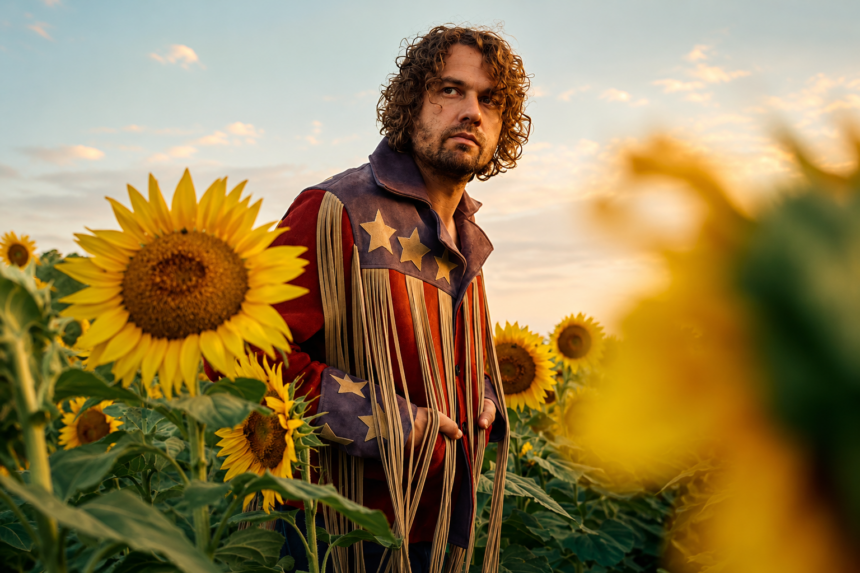
Kevin Morby’s eighth album ‘Little Wide Open,’ produced by Aaron Dessner, is his most cohesive, tuneful, and emotionally assured record yet
There is a certain kind of artist who arrives fully assembled, brilliant from the first note. Kevin Morby is not that artist, and that is precisely what makes “Little Wide Open“ feel like such an event. His eighth studio album, released May 15 via Dead Oceans and produced by Aaron Dessner, is the record where the long game pays off in full. The most cohesive, tuneful, and emotionally clear album of his career, it arrives not as a reinvention but as a homecoming to something Morby has been circling for years without quite landing on it until now.
Dessner came to this collaboration on his own initiative. After Morby opened for the National at Crystal Palace Park in London in the summer of 2024, Dessner reached out directly: he wanted to produce Morby’s next record. They began work at Long Pond Studio in Stuyvesant, New York, in early 2025 and finished that September, and the resulting album is the third in what Morby describes as an unintentional trilogy, following 2020’s “Sundowner” and 2022’s “This Is a Photograph.” Those records catalogued a return to Kansas City, a deliberate slowing down. “Little Wide Open” captures what comes after: the acceptance of motion, time, and fragility as the conditions of a life rather than problems to be solved.
The Midwest as Sound and Metaphor
The album’s governing image is not a place but an event. Driving through Arkansas, Morby watched butterflies repeatedly hit his truck as they crossed the highway, and that collision, at once tragic and beautiful, became the emotional center of the record. “We’re floating around,” he has said. “Flying over the highway like we are not butterflies. Like we are not fragile.” But they are. We are.
That awareness runs through every track: the mortality questions in “Die Young,” where Mat Davidson’s violin pulls against Morby’s voice; the centrepiece “Natural Disaster,” a slow builder with Justin Vernon’s guitar and a verse sung by Lucinda Williams that is among the most quietly devastating things on the record; the title track itself, with banjo from Dessner, pedal steel from Colin Croom, and Katie Gavin’s backing vocals wrapping around Morby’s admission that his body is not built to outrun time.
Dessner’s production is the best argument for his instincts as a collaborator rather than a stylist. The record sounds nothing like the National, and nothing like the pop records Dessner has produced for Taylor Swift, Ed Sheeran, or Gracie Abrams. It sounds like Kevin Morby, more clearly than any previous Morby album. As one press essay puts it, the production “elevates Morby’s recordings while never losing focus of the songs themselves,” a restraint Morby acknowledges with characteristic directness: “Aaron did a heroic job of holding me back from throwing too many tricks at the songs, and letting my stories stand a bit naked.”
A Career’s Worth of Patience, Delivered
The guest list is extensive, but it earns its length. Amelia Meath of Sylvan Esso appears on lead single “Javelin,” a propulsive account of the particular longing of returning home alone to the Midwest after circling the globe for someone. The video, shot on Missouri backroads with comedian Caleb Hearon and a cameo from Waxahatchee’s Katie Crutchfield, captures the same spirit the song does: movement as both joy and ache, simultaneously.
The album also features contributions from Bon Iver’s Justin Vernon, Meg Duffy of Hand Habits, MUNA’s Katie Gavin, the Barr Brothers’ Andrew Barr, and Twin Peaks’ Colin Croom, among others, all of whom serve the songs rather than announce themselves. Critically acclaimed novelist Rachel Kushner contributes an accompanying essay, “Field Guide to the North American Troubadour,” which frames Morby’s current relationship with time in terms that the album earns: “He has accepted that time is ceaselessly flowing, and you can’t stop it. Instead, he feels like he’s riding it. He’s riding passenger with time.”
That is precisely what “Little Wide Open” sounds like. An artist who has stopped trying to hold the past in place and discovered, in letting go, that he had something more interesting to say about the present. It is amazing to see a musician arrive fully formed. But there is something more edifying, in light of the lives most of us live, to watch an artist build a greatness steadily over years. Kevin Morby is one of those. This is where he arrives.
“Little Wide Open” is out now via Dead Oceans.