




Beabadoobee closes her fourth album ‘Pylon’ with ‘Satellite,’ a quiet-to-crushing duet featuring Deftones frontman Chino Moreno
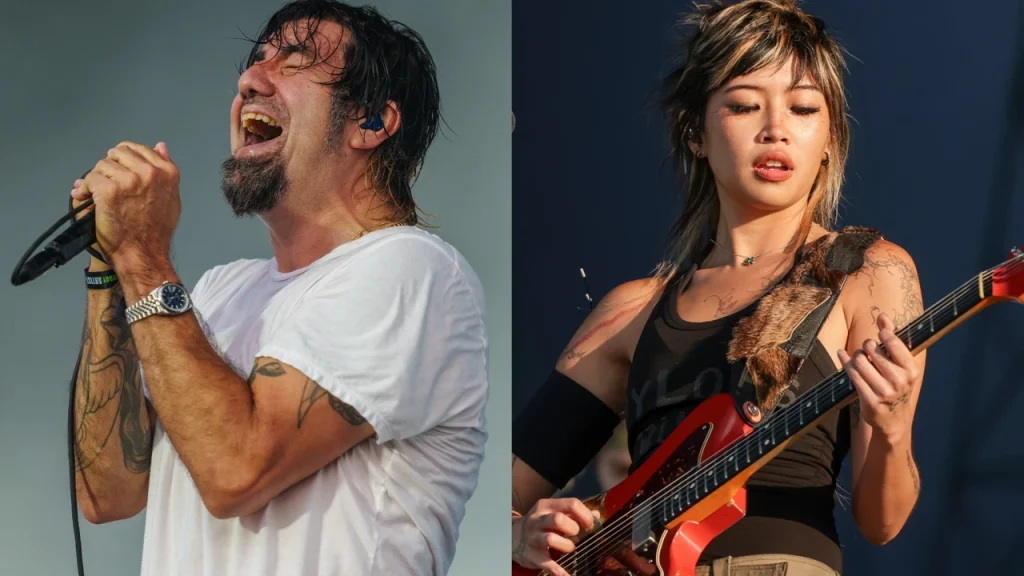
Chino Moreno has spent three decades as alt-metal’s most seductive contradiction, a singer who can whisper and roar in the same bar and make both sound like longing. On “Satellite,” the closing track of Beabadoobee‘s fourth album Pylon, released September 18 via Dirty Hit and Interscope, he doesn’t take the wheel. He hovers. The Deftones frontman is credited only with background vocals, and that restraint is exactly why the song works: this is Beatrice Laus’s record, and Moreno arrives as atmosphere rather than headliner.
The song opens small. Low acoustic strums, a softly tapped drum pattern and guitar effects that glint like distant light frame Laus at her most hushed, singing about a relationship reduced to late phone calls and the silence after the line goes dead. Then the floor drops out. The chorus erupts into thick, distorted alt-rock, and on its second pass Moreno slides in beneath her, bending his familiar deep-drawn cries into harmonies that thicken the blur instead of cutting through it. The central image, a narrator circling someone she can no longer reach, is the whole album’s thesis compressed into five minutes.
A Lineage Made Audible
It is tempting to hear “Satellite” as a novelty crossover, a former bedroom-pop kid borrowing credibility from alt-metal royalty. That reading misses the architecture. The quiet-loud dynamic is Deftones’ native tongue, the gauzy shoegaze undertow of White Pony and Saturday Night Wrist, here filtered through Laus’s ’90s alt-rock obsessions. At least one early reviewer heard the track as a sister song to “Rosemary,” the slow-bloom epic from Deftones’ Koi No Yokan, and the comparison holds: both songs treat heaviness as weather rather than aggression.
Title Fight guitarist Shane Moran co-wrote “Satellite” along with six other Pylon tracks, which explains the midwest emo grain in its guitars. Laus has framed the record as a collision of classic grunge, midwest emo and ’90s radio rock, and the guest list reads like a map of those coordinates: Paramore’s Hayley Williams on “Nothing to Prove,” Turnstile’s Brendan Yates co-leading “Powerlines,” Pinegrove’s Evan Stephens Hall on “Spark,” and The 1975’s Matty Healy and George Daniel in the credits. Laus, who has a Pinegrove tattoo, is not name-dropping. She is building a genealogy.
She also pointed to a less obvious ancestor. Asked by Radio X which artists guided Pylon, she named Bloc Party without hesitation, which fits the album’s nervous, forward-leaning energy.
From Bedroom Pop to Arena Rock
The timing matters. Laus first surfaced as a teenage bedroom-pop artist in 2017 with “Coffee.” Pylon, written on the road while she toured 2024’s This Is How Tomorrow Moves, arrives as she steps up to her first arena tours across the UK, Europe and North America. The title came from the electricity pylons she passed between shows, steel towers that became an unlikely emblem of home. Bigger rooms demand bigger sounds, and “Satellite” is engineered for them.
NME’s four-star review of Pylon singled the track out as a showcase for her emotional maturity as a songwriter, and it’s hard to argue. The song resolves nothing, which is precisely its point.
Laus still sounds a little stunned by the company she now keeps. Speaking about Moreno, Williams and the rest of the album’s guests, she told Radio X that their willingness to join “something that feels so special to me just meant a whole lot.”
Her North American arena dates begin next month, with a UK and European run following in November, including stops in Glasgow, Cardiff, Manchester and London’s The O2. Moreno, meanwhile, arrives fresh from Deftones’ biggest UK headline show to date, a bill-topping set at London’s Outbreak x All Points East last month.
“Satellite” ends Pylon mid-orbit. It doesn’t land. It isn’t supposed to.