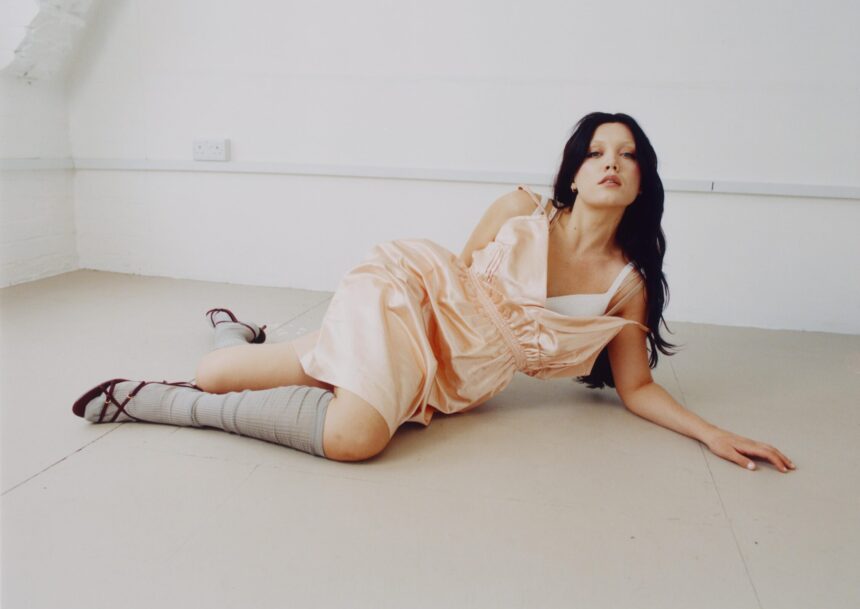
Alessi Rose on the honesty behind ‘Skin’ and ‘Dependent,’ building her debut album in public, and finally wanting to be a pop star
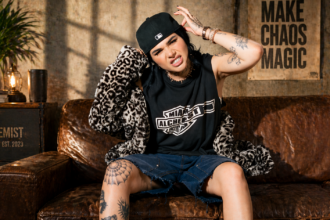
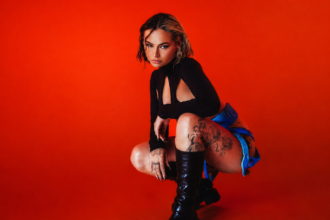
Alessi Rose played 128 shows in 2025, and somehow 2026 is busier. The 23-year-old from Derby said as much backstage at Latitude Festival in Southwold on July 24, where she subheadlined the Second Stage a couple of years after playing her first-ever festival set on the same site. Between festival slots at NOS Alive, BST Hyde Park, and Lollapalooza Berlin, support runs with Lewis Capaldi and Lorde, and two new singles that arrived within weeks of being written, she is in the middle of the most relentless stretch of a fast-rising career, and she is using all of it as raw material.
The two songs at the center of her year, “Skin” and “Dependent,” came from the same uncomfortable place. “Skin” was written after that punishing 128-show run ended and the noise suddenly stopped. “Sitting in my childhood bedroom, I felt like a failure because everything was suddenly just so quiet,” she said.
“Because of my OCD, I need to be busy all the time to feel like I’m channelling my emotions into the right place.” The breakthrough came when she stopped forcing it. “The minute I just started talking about how I was actually feeling, ‘Skin’ happened.” “Dependent” followed the same pattern, a song about being self-assured and still craving validation inside a relationship, someone to carry the weight of her difficult emotions.
Releasing the Process, Not Just the Product
What makes Rose unusual is how fast she is willing to turn feeling into release. Both singles arrived a couple of weeks after they were written, and that immediacy is a deliberate philosophy rather than an accident of scheduling. “It doesn’t make any sense for me to disappear for 18 months and return with a finished album,” she said, recalling how she used to leak new songs on livestreams the moment she made them because she was too excited to wait. “I want to share the process with fans.”
That approach frames the two singles as dispatches from an album still being written. “They’re saying that I’m doubling down on the honesty,” she said. “I tend to find the most comfort in my own music when I’ve said something that’s true and a bit weird, and it’s the same with the fans.” It is the throughline of everything she has made, from the self-produced 2023 debut “Say Ur Mine,” recorded on a cracked copy of Logic Pro X and a fifteen-year-old Mac, through the three EPs that followed, culminating in last year’s Voyeur, the record where her themes of worship, love, and biblical imagery finally locked together.
Reclaiming the Word “Pop Star”
The most interesting turn in the conversation is about ambition. Rose grew up on Madonna, Taylor Swift, and Lorde, but for years she resisted the label that came with them. “I always wanted to be seen as an artist,” she said. “There was this damning tint put on pop music. People often like to negate the talents of women.” That has changed. “Now, fuck yeah, I want to be a pop star. All the best ones are incredible artists and visionaries in their own right.” She points to Olivia Rodrigo, who moves between genres while her lyricism holds everything together, as the model for the flexibility she wants.
Her currently-in-progress album is soaking up a wide range of influences: old Taylor, Madonna’s debut, Grace Ives, Geese, and a lot of rock and electronic music, and “Skin” already marked a shift toward a rock-influenced pop direction. But the constant is the confessional writing that led NME to call her pop’s most brutally honest newcomer.
She is disarmingly clear about why it connects. “Really, in the grand scheme of things, I am a normal 23-year-old from Derby who wrote songs in her bedroom.” A lot of her audience are young girls working through the same things she is. “That’s so validating. It makes me realise I’m not alone.”