




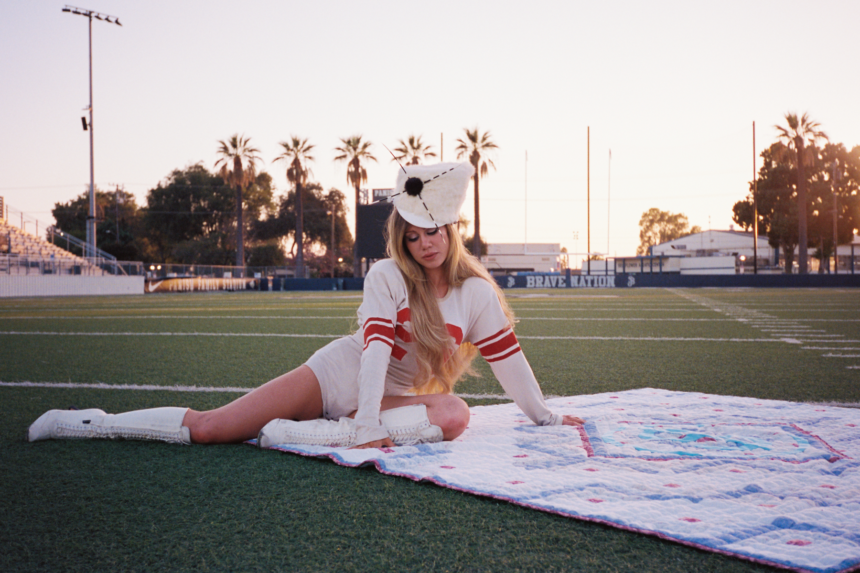
Slayyyter shares ‘brand new chanel,′a self−directed video and lead single from her up coming LP′Wort Man in America’
Slayyyter has released “brand new chanel$,” a self-directed music video and single that arrives on July 31 as the lead offering from her upcoming fourth studio album, Wor$t Man in America. The track lands mid-stride, dropped during a sold-out world tour that opened with three hometown shows in St. Louis, and it functions as the deliberate inverse of “BEAT UP CHANEL$,” the lead single from her breakout 2026 LP Wor$t Girl in America. Where the earlier song weaponized heartbreak into punk-adjacent aggression, this one metabolizes the same wound into something shimmering, sad, and almost hopeful.
That inversion is the entire premise. “brand new chanel$” belongs to a sister project that reimagines and flips tracks from Slayyyter’s major-label debut, and it wears its counterpart’s DNA openly. The self-directed video returns to the same house featured in the “BEAT UP CHANEL$” clip, revives that video’s fireworks shot, and recreates the Wor$t Girl in America album artwork upside down. If “BEAT UP CHANEL$” paired a pounding verse with an electroclash chorus, its twin is all lights and sparkles, at least on the surface.
Underneath the gloss, the writing is unusually plain-spoken for an artist who built her name on maximalist irony. “Send another weak ‘I’m sorry,’ unforgivable as always,” she sings. “I know you had seen somebody / Was it worth causing all my darkest days?” The betrayal is literal. In a recent conversation with Owen Thiele, Slayyyter revealed the infidelity that inspired the song surfaced only days before her Coachella performance, a detail that reframes the track’s brightness as a kind of survival strategy rather than closure.
A Softer Palette, a Sharper Wound
Sonically, this is Slayyyter reaching for millennial optimism. The production, co-written and produced by Austin Corona and Wyatt Bernard, layers washed-out synths, live drums, and stacked ethereal chants into an electropop frame that borrows from electro house without collapsing into it. The chorus carries an enormous, haunting synth line that lands with an almost Hans Zimmer-scaled emotional severity, a strange and effective pairing with lyrics about being cheated on while far from home.
The result is what The FADER memorably called “girl who’s going to be okay pop,” a framing that captures the song’s central tension. Slayyyter puts her foot down (“What a chop, I cut you off and get away / I’m better off”) while the chorus admits she is still standing in the rubble (“I see how you move / But I’m here standing still”). BrooklynVegan echoed the read, describing the track as more uplifting than its predecessor. It is a song about recovery that is honest enough to admit recovery is not finished.
The Wor$t Man Era Begins
The stakes here are commercial as well as critical. Wor$t Girl in America debuted at No. 1 on Billboard’s Top Dance Albums chart and gave Slayyyter her first Billboard 200 entry at No. 22, while Pitchfork named it Best New Album. “brand new chanel$” is the first official release since that record, and it doubles as the opening statement of the Wor$t Man in America era, an album with no announced release date yet.
The timing amplifies the song’s themes. Slayyyter is busier than she has ever been across a near-decade climb from the pop underground, with a sold-out trek running through November 5 in London and festival stops at Lollapalooza, Reading and Leeds, and All Things Go. The whiplash of sudden fame hums beneath every sparkling synth. For an artist whose persona once thrived on distance and camp, “brand new chanel$” is a quietly radical move toward feeling the thing directly.