


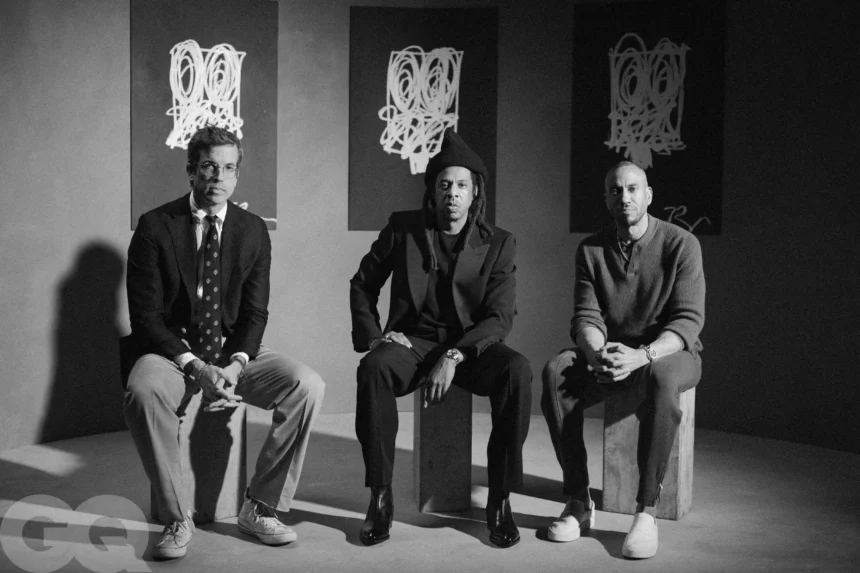
Jay-Z has never been a man who gives his words away cheap. So when Hov sat down with GQ senior editor Frazier Tharpe for what turned out to be one of his most revealing interviews in nearly a decade, the culture paid attention. The conversation, published March 24, lands as Jay prepares to return to the stage this summer for back-to-back Yankee Stadium shows celebrating the 30th anniversary of Reasonable Doubt and the 25th anniversary of The Blueprint. Both nights sold out near-instantly, with more than 1.6 million fans joining the ticket queue, forcing a third “Extra Innings” date on July 12. The man still moves the crowd before he even steps onstage.
But the most charged section of the interview was not about concerts or business empires. It was about the Kendrick Lamarand Drake beef, and what Jay thinks it cost the culture.
Hov Questions Hip-Hop’s Last Pillar
Jay came at it sideways, the way he always does when he has something real to say. He framed the Kendrick-Drake war through the lens of hip-hop‘s “four pillars”: breakdancing, graffiti, DJing, and battling. Three of the four, he said, have already drifted from the center of the culture. Breakdancing became an Olympic sport. Graffiti went from tagging trains to gallery walls. The DJ, once the anchor of every bill, became background noise for acts that do not even credit them. That left battling as the last pillar still standing in hip-hop’s original foundation. And now, Jay said, even that one might need to come down. “We’ve just grown so much that I don’t know if battling needs to be part of the culture anymore,” he told Tharpe. He said it slow. He said he hated having that opinion. But he said it.
The issue, in Hov’s view, is not the sparring itself. It is what social media does to the fallout. Before the internet, a beef was an event. You had it, music got made, and then life moved on. Now, a beef becomes a permanent faction war with no off switch. “People that like Kendrick hate Drake, no matter what he makes. It’s like an attack on his character,” he said. He called bringing kids into diss tracks a line that should not have been crossed. “It’s trying to tear down people’s lives. I love that we got so much music in such a short period of time. Just everything around it was like, ‘Man, this is taking us a couple steps back.'”
He did not just observe from a safe distance. He admitted his own hypocrisy directly, calling out his notorious early-2000s war with Nas, and specifically the personal nature of the “Super Ugly” diss track. “I actually regret that because I really like Nas,” he said. “It takes growth to arrive at this place, because I’ve done the bullshit too.”
Stan Culture, the Far Right, and a Rare Billboard on the Bigger Picture
In a separate written message to Tharpe after the sit-down, Jay escalated the conversation to a political dimension that cut deeper than anything discussed in the recorded interview. He connected toxic stan culture directly to the rise of the far right. “There is clearly an agenda to silence voices in our community, a heavy right wing agenda,” he wrote. “And the culture is happily playing along in the name of this insane thirst of Stan culture to have something on the other side.” It was a sharp, unambiguous read, the kind that rarely lands in mainstream press without being softened.
He also pushed back against the perception that his decision to tap Kendrick for the 2025 Super Bowl halftime show was a deliberate move against Drake. “I chose the guy that was having a monster year. I think it was the right choice. What do I care about them two guys battling? What’s that got to do with me?” He dismissed the conspiracy framing entirely. On Bad Bunny’s 2026 halftime performance, he contextualized it as part of a deliberate correction to decades of the NFL platforming “only one side of music.”
On new Jay-Z music, he offered no timeline but more clarity than he ever has. He said he came close to appearing on the Clipse comeback album Let God Sort Em Out, but ultimately held back because he felt his first statement had to come entirely on his own terms. He acknowledged that last year he was too angry to make something constructive. “I got to get this shit out,” he said. “I don’t know if it would have done more harm than good.” He also addressed the 2024 sexual assault lawsuit once more, repeating his denial and reconfirming that he refused to settle. The accuser later dropped the lawsuit with prejudice.
The GQ cover, Jay’s first in nearly a decade, is less a press moment than a declaration. “We played enough defense,” he told the magazine. “2026 is all about offense.”