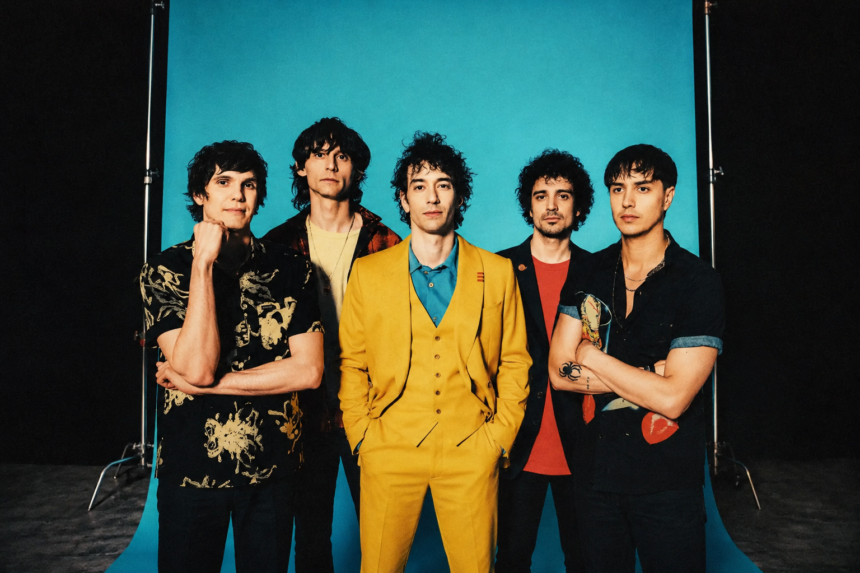
The Strokes push further into the weird on ‘Reality Awaits,’ their seventh album and second with Rick Rubin. Our review of a divisive, ambitious record
Twenty-five years after Is This It made them the last great back-to-basics rock band, The Strokes have made an album that sounds like it was recorded in a room where nobody was allowed to say no. Reality Awaits, out June 26 via Cult Records and RCA, is the New York group’s seventh studio album and second consecutive collaboration with Rick Rubin, and it picks up the thread of 2020’s Grammy-winning The New Abnormal only to pull it somewhere stranger. This is the sound of a band that, well into its members’ forties, has run out of interest in meeting anyone’s expectations, including its own fans’.
The strangeness is the point and the problem. Julian Casablancas has always had a weakness for vocal effects, and here he goes all the way, deploying AutoTune as a stylistic weapon across multiple tracks, ad-libbing in an over-the-top English accent, and repeating “I’m a leech” on “The Fruits of Conquest” until it becomes something between a mantra and a dare. Opener “Psycho Shit” beckons you in on an ominous arpeggio and ethereal swells rather than a riff. Closer “Tyrants of the Mellow Moon” folds in Radiohead atmospherics and a stray ’80s guitar solo. Somewhere in the middle, “The Fruits of Conquest” slinks along on hand drums and tropical disco-rock that betrays the album’s Costa Rica recording sessions.
A Band Rewarded for Refusing to Repeat Itself
The critical response has split along a predictable fault line: how much indulgence you will forgive from a band that earned the right to it. NME heard a band on playful, joyous form, allying the crackpot strangeness of Casablancas’ side projects with the Strokes’ gift for pop minimalism, and called it their most thematically cohesive record. Rolling Stone found it enjoyable, often inscrutable, and sometimes straight-up bizarre. AllMusic was less charmed, describing a record made in a vacuum where the band spends a fair amount of time getting in its own way, admirable in its rejection of simplicity but not always rewarding.
Both readings are fair, which is what makes Reality Awaits interesting rather than merely divisive. The New Abnormal worked because its sprawl was held together by obvious passion and Rubin’s instinct for when to rein Casablancas in. Reality Awaits keeps the sprawl and loosens the leash. When it connects, on the disco-rock lurch of “Fruits of Conquest” or the melodic turns buried in “Going Shopping,” it justifies the risk. When it doesn’t, it circles its own themes of corruption, regret, aging, and nostalgia without quite landing them.
The Most Improbable Comeback in Rock Keeps Going
The context is what makes any of this land at all. The Strokes’ stock in 2026 is arguably higher than at any point since their debut, buoyed by a 20-year nostalgia cycle that handed them a generation of teenage fans and a triumphant return to touring, their first proper run in two decades. They played directly before Justin Bieber on Coachella’s main stage this year, a booking that would have been unthinkable a decade ago when the band seemed content to be absent icons. Millions of listeners want new Strokes bangers, and one Irish Times headline even asked whether Casablancas could save rock and roll.
Reality Awaits is not that album, and it is not trying to be. It is the sound of a band that already survived its own comeback and now feels free to chase whatever Casablancas finds interesting, commercial logic be damned. That freedom is the reward of their improbable second act, and it is also its risk. For a group that spent years accused of coasting on a formula, an album this willfully strange is its own kind of statement: The Strokes would rather be weird than safe. Whether that is a triumph or a frustration depends entirely on how much you trusted them to begin with.