



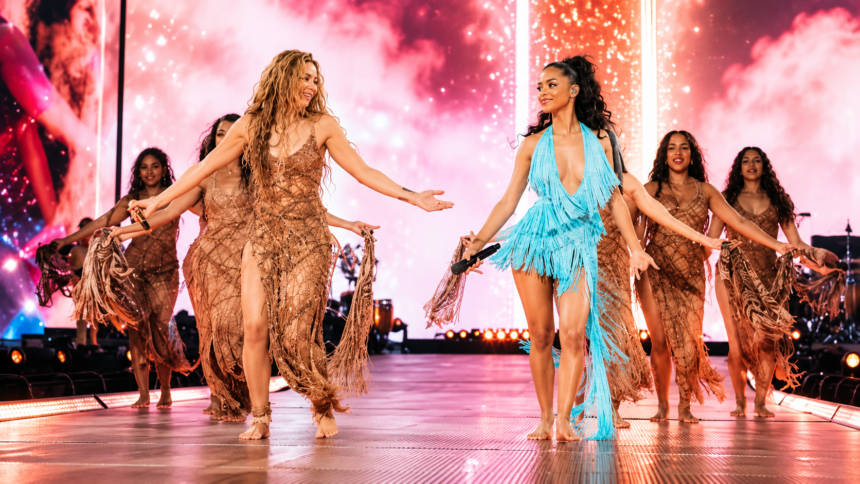
Tyla joined Shakira to perform ‘Hips Don’t Lie’ at Brooklyn’s Barclays Center, days before her sophomore album ‘A*POP’ arrives July 24
Some cosigns you cannot buy, and on Sunday night Tyla got one of the biggest in modern pop. The South African star joined Shakira on stage at Brooklyn’s Barclays Center for a jubilant performance of “Hips Don’t Lie,” the 2006 juggernaut that remains one of the best-selling singles of all time, days before Tyla releases her own sophomore album. The moment landed at a near-perfect point in both artists’ calendars: Shakira is in the middle of a sold-out North American run and fresh off a globe-spanning World Cup halftime slot, and Tyla is on the final approach to A*POP, out July 24 via FAX and Epic Records.
The optics were the point. Shakira, who performed her World Cup final halftime segment to a television audience estimated around 100 million, could have brought out almost anyone. She chose the 24-year-old behind “Water,” and the pairing read as a torch-passing between two artists who each carried a regional sound to global ubiquity, Shakira from Colombia in the 2000s, Tyla from South Africa in the 2020s. Footage of the duet raced across social media overnight, with fans celebrating Tyla sharing a stage and a signature hip-driven anthem with the woman who made that vocabulary a worldwide language. The clip, in the parlance, broke the internet.
A Perfectly Timed Album Rollout
For Tyla, the timing could hardly be sharper. A*POP arrives Friday as the follow-up to her Grammy-winning 2024 self-titled debut, the highest-charting album by an African female soloist on the Billboard 200, and she has spent the rollout making bold choices. The 14-track record is led by “Chanel,” which spent 17 weeks on the Hot 100 and topped Billboard’s Afrobeats and Rhythmic Airplay charts, and “She Did It Again,” her collaboration with Zara Larsson.
Tyla has branded the album’s sound “popiano,” a fusion of pop, R&B, and the South African amapiano that shaped her, and she recently unveiled the tracklist by spray-painting song titles across a blacklight room. A duet with Shakira, days before release, is the kind of promotional exclamation point money genuinely cannot manufacture.
It also deepens a relationship that has been building in public. The two share a label home at Epic, and Tyla has repeatedly cited Shakira among the crossover blueprints she studied, making the Barclays Center invitation feel less like a random guest slot than an endorsement from a mentor figure. For an artist still proving her breakout was a foundation rather than a fluke, standing shoulder to shoulder with a pop institution on that institution’s most iconic song is a statement of arrival.
Two Eras of a Global Sound
The larger resonance is what “Hips Don’t Lie” represents. When Shakira and Wyclef Jean released it in 2006, it became a cultural passport, a Latin-pop crossover that proved a non-Anglophone sound could dominate American radio outright. Twenty years later, Tyla’s rise is the latest chapter in that same story, part of an African pop wave that has pushed Afrobeats and amapiano from regional scenes onto the Grammy stage and the Billboard charts. Watching the two of them trade the song’s hook, generations and continents apart, made the lineage explicit.
Shakira’s tour rolls on, and Tyla’s real test arrives Friday when A*POP faces the market. But Sunday night handed her something no first-week number can measure: a viral, joyous, unmistakable blessing from one of the few artists whose path she is genuinely following. In a rollout full of smart moves, it may prove the smartest.