



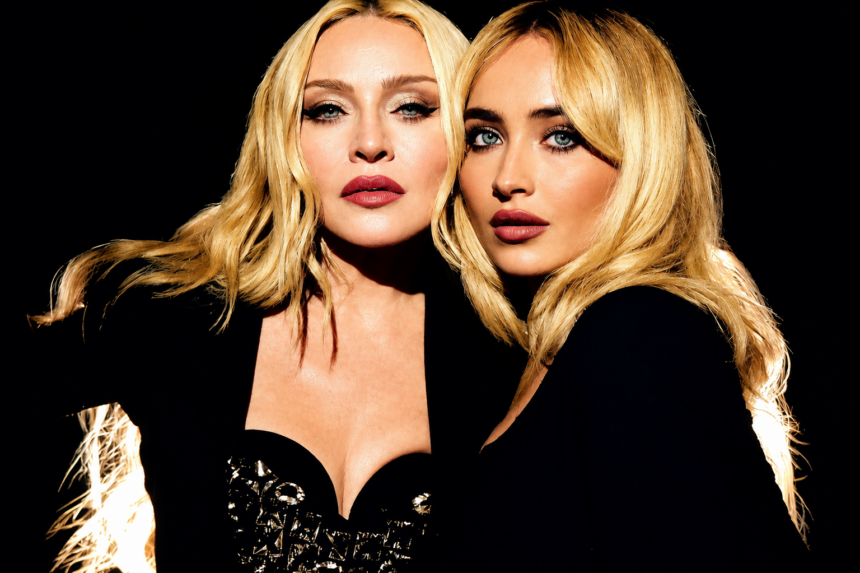
Madonna and Sabrina Carpenter release ‘Bring Your Love,’ the lead single from ‘Confessions II,’ out July 3 via Warner Records. A house-pop triumph
Released April 30 via Warner Records, “Bring Your Love“ is the lead single from Madonna’s fifteenth studio album Confessions II, arriving July 3 as the long-awaited sequel to her 2005 landmark Confessions on a Dance Floor. Co-written and produced by Madonna and Stuart Price, with additional song writing credits going to Kevin Saunderson, Roy Holman, and Shanna Jackson for the sample of Inner City’s 1988 house classic “Good Life,” the track reunites the exact creative engine that powered the original record. It debuted live on April 18 when Madonna made a surprise appearance during Sabrina Carpenter’s headlining Coachella set, running through “Vogue,” “Get Together,” and “Like a Prayer” before closing the night. The studio version has since hit No. 1 on iTunes in 34 countries and landed on BBC Radio 1’s A-List playlist for the first time since 2008.
In Madonna and Stuart Price’s manifesto for Confessions II, the duo has tapped into the transcendental properties of dance music. “Sound, light, and vibration/Reshape our perceptions/Pulling us into a trance-like state,” the pop legend wrote in a press release. “The repetition of the bass, we don’t just hear it, but we feel it. Altering our consciousness and dissolving ego and time.” This conception of dance music as channeling an elevated presence of mind in an unbound flow state is both galaxy-brained and complete nonsense. But what has always separated Madge from reams of cheap rave garbage is exquisite taste and sheer star power. Even when what she’s singing about never quite adds up, she still sounds great doing it.
Two Icons, One Dancefloor
The struggle that Madonna and Sabrina Carpenter join forces against on “Bring Your Love” is extremely vague and nonsensical. But damn if it isn’t fun. Taking a fragment of Inner City’s “Good Life” and buffing it into a constantly peaking staircase of a beat, Stuart Price constructs an elegant platform for both Carpenter and Ciccone. In the proud lineage of pint-sized blonde women who’ve held their own against Madonna, Carpenter acquits herself quite well. Even if house music isn’t her natural wheelhouse, “bless your heart” bitchiness certainly is, and she sells the song’s unwieldy barbs to the best of her ability. The lyrics see Madonna and Carpenter addressing critics and rejecting external judgment about their careers and public personas. Carpenter opens with “your vision of me is a killer of joy” before Madonna fires back with typical directness. The approach reflects a rollout strategy that has been building pressure since “I Feel So Free,” the album’s first preview track, which debuted on iHeartRadio’s Pride Radio before hitting streaming services and climbing immediately. At the Abbey in West Hollywood, at an invite-only Club Confessions Los Angeles event, Madonna appeared behind the DJ booth at 1 a.m. and told the crowd, “Hello children, mutha is here to save you.” It is the most Madonna sentence imaginable and it captures exactly why this single works.
Lyrical Confusion, Musical Certainty
“Bring Your Love” and lead single “I Feel So Free” operate on the idea that the dancefloor is a contested space where Madonna isn’t fully welcome, a premise that gay clubs and the entire nation of Brazil would be among the first to dispute. But this lack of detail leads to other distortions. “I know where the bodies are buried,” Madonna sings in an airbrushed purr, giving the track an unexpected jolt of neo-noir. “Don’t try to distract me with numbers,” Sabrina follows up, as if the door policy hinged on answering an algebra problem. Even if you can never quite get to the bottom of “Bring Your Love,” in the interplay between its lyrical confusion and musical certainty, it has the funny effect of re-shaping your perceptions and pulling you into a trance-like state.