




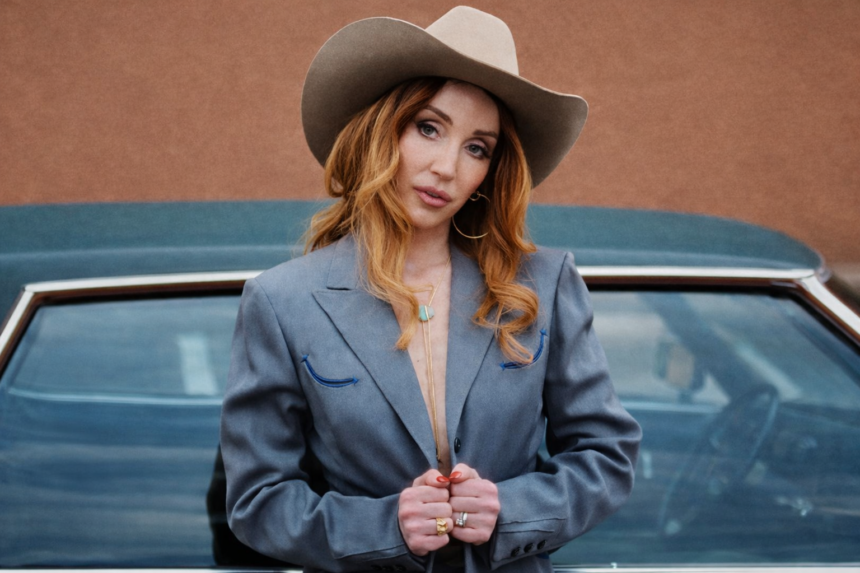
Ashley Monroe has spent 23 years inside the machine that makes country music run, and on her surprise album Dear Nashville, released March 27, she finally describes exactly what that machine has done to her. The eight-track concept record, co-written and co-produced entirely with songwriter Luke Laird, opens with a title that doubles as a provocation: “I Hate Nashville.“ It is a declaration from a woman who arrived in Music City as a girl from Knoxville with a dead father and a dream too big to ignore, and who has spent more than two decades watching that dream get rationed back to her in pieces.
Monroe is 39 now. She has three Grammy nominations, two No. 1 songs, and a songwriting résumé that includes Jason Aldean’s “The Truth” and Miranda Lambert’s “Heart Like Mine.” As one third of the Pistol Annies alongside Lambert and Angaleena Presley, she helped forge a template for fearless, feminine country music. She has also been signed and dropped by multiple labels, sung backup on records for artists with a fraction of her talent, and walked into industry events where the room looked straight through her. Dear Nashville is where all of that accumulated weight finally lands.
The Song That Started Everything
The album grew from a single writing session. Monroe arrived at Luke Laird’s house one morning carrying what she calls “a storm in my heart.” She needed to get something out before the day could begin. “I had a writing session on the books with Luke and I’d woken up that morning with a storm in my heart, like, ‘My gosh, have I done this all for nothing?'” Monroe explains. “When I got to Luke’s house that day, I knew I had to address my hurt feelings and get it out of my system. I told him the idea of ‘I Hate Nashville’ and he loved it. That song put everything into motion. We felt the window of all the muses open, and decided that I’m going to say what I feel and make it a whole project.”
The song itself is not simple rage. Critics have noted that the production leans into a hazy, retro palette, with pedal steel and a faint psychedelic shimmer that softens the blow without dulling the meaning. There is a wink embedded in the track: Monroe name-checks “Paul Franklin playin’ steel” as one of the things she loves about Nashville, and Franklin himself plays pedal steel on the recording. Monroe sings plainly about a city that “takes the best years of your life,” a sentiment that carries real lyrical predecessors, from Caitlyn Smith’s “This Town Is Killing Me” to Hailey Whitters’ “Ten Year Town.” But Monroe’s version carries a specific weight. She is not a newcomer venting frustration. She is someone who made it by nearly every measurable standard, and is still not recognized in the way the work demands.
The Instagram letter Monroe posted before the album’s surprise release crystallized exactly what the album is about. She wrote about leaving Knoxville after her father died, arriving in Nashville with nothing but faith, and building a career that the industry never fully embraced on its own terms. The moment that finally broke something loose came last fall. “After attending an industry event, it hit me so hard it took my breath away,” Monroe wrote.
They’re never gonna see me. In that moment, I finally let myself feel how sad that makes me”
A Record That Speaks for More Than One Artist
The post landed with force. Artists flooded the comments section with responses that read less like supportive replies and more like confessions. Priscilla Block wrote that Monroe’s courage to say things others wouldn’t was something she had long admired. Lauren Alaina called Monroe’s words “the most honest thing I’ve read in the longest time.” Martina McBride, Sara Evans, LeAnn Rimes, Ashley McBryde, Tenille Townes, Brittney Spencer, Brandy Clark, and Runaway June’s Jennifer Wayne were among the many who showed up in the comments. The breadth of that response is its own kind of data point about how widely this particular feeling circulates in Music City, even among people who have found commercial success there.
Laird, who has written for Eric Church and Kacey Musgraves and is one of Music Row’s most decorated collaborators, explains what the project meant to him personally. “The music is what brings most songwriters to this town, but when it comes to the business, that’s when people can get burned out,” he says. “So Ashley and I talked that day about our love for country music, the songs and the people. We had such a good day talking about all of our favorite Nashville memories and what led us both here. I love how honest Ashley is in her writing and just how pure her singing is. She really is the triple threat: artist, songwriter, and producer. We had so much fun making this record. No rules, just what felt right.”
The album is dedicated to “all the dreamers who never stop dreamin’.” Its central theme, as Monroe frames it, is unrequited love in the broadest possible sense. “The bottom line of the album is, I wish you loved me like I love you,” she says. That line reaches past Nashville as a geographic target and describes something more universal: the specific ache of pouring yourself into something that does not pour back. Across eight tracks, from the opening confrontation of “I Hate Nashville” to the resigned resolution of “Quittin’,” Monroe works through every stage of that particular grief without flinching.
Dear Nashville arrives as an independent release, which is fitting for an album about what major label culture has cost her. It follows 2025’s Tennessee Lightning and arrives without advance promotion, without a radio campaign, without a label rollout. Just the music, the voice, and the reckoning she has been building toward for more than two decades. Monroe is supporting Stephen Wilson Jr.’s Gary the Torch Tour through April, carrying this album with her into rooms where people will hear her whether the industry acknowledges it or not.